

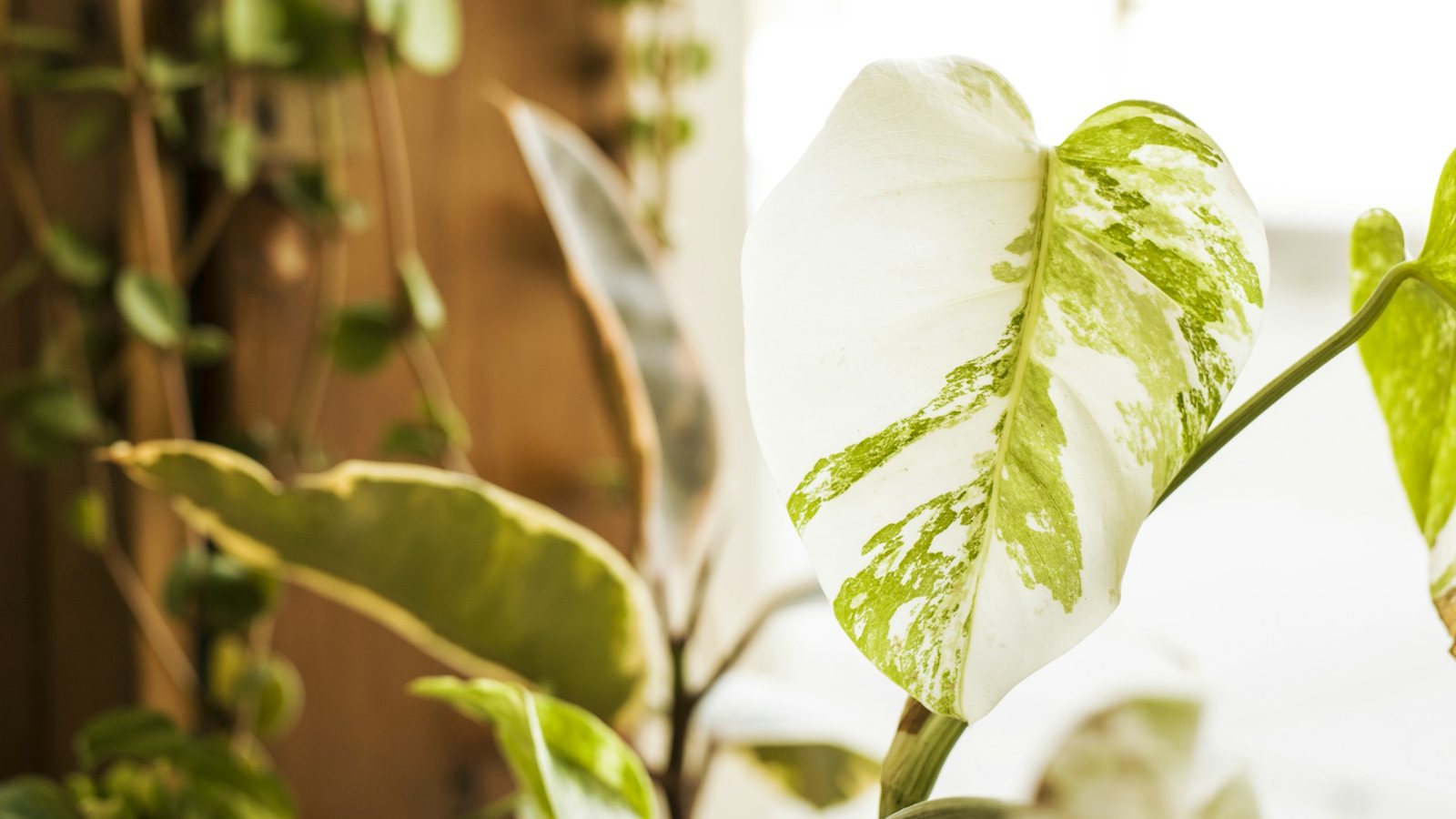
What does variegated mean in plants? It describes a leaf or stem with two or more colors in distinct zones. Usually that means green mixed with white, cream, yellow, or silver.
The pattern can come from mutated cells, trapped air, the plant’s own genes, or a virus. Each cause behaves differently. That difference decides how much light the plant needs and whether the pattern will last.
What does variegated mean in plants?
Variegated plants carry leaves with patches, stripes, edges, or speckles in a color other than the base green. The pale zones either lack working chlorophyll or only look pale because of how the leaf reflects light. That second group surprises most growers.
Variegation is common among foliage plants grown for their leaves, because a patterned leaf is the main attraction. Nurseries select the best patterns as named cultivars. Most are multiplied by cuttings or tissue culture so the pattern carries over.
How plants become variegated
A 2012 Begonia study in Annals of Botany uses the Hara scheme, which splits variegation into pigment and structural types. Gardeners usually meet four versions in practice.
Chimeras: a mutated layer of cells
Most variegated houseplants are chimeras, with tissues of two different genotypes in one plant. The shoot tip has three cell layers, LI, LII, and LIII. The University of Florida’s propagation course explains that LI forms the epidermis, LII the next layer, and LIII the core.
If a mutation stops one layer from making chlorophyll, every leaf from that tip inherits the pale layer. A white-edged leaf often comes from a “sandwich” chimera, where a colorless LII layer shows through at the margin.
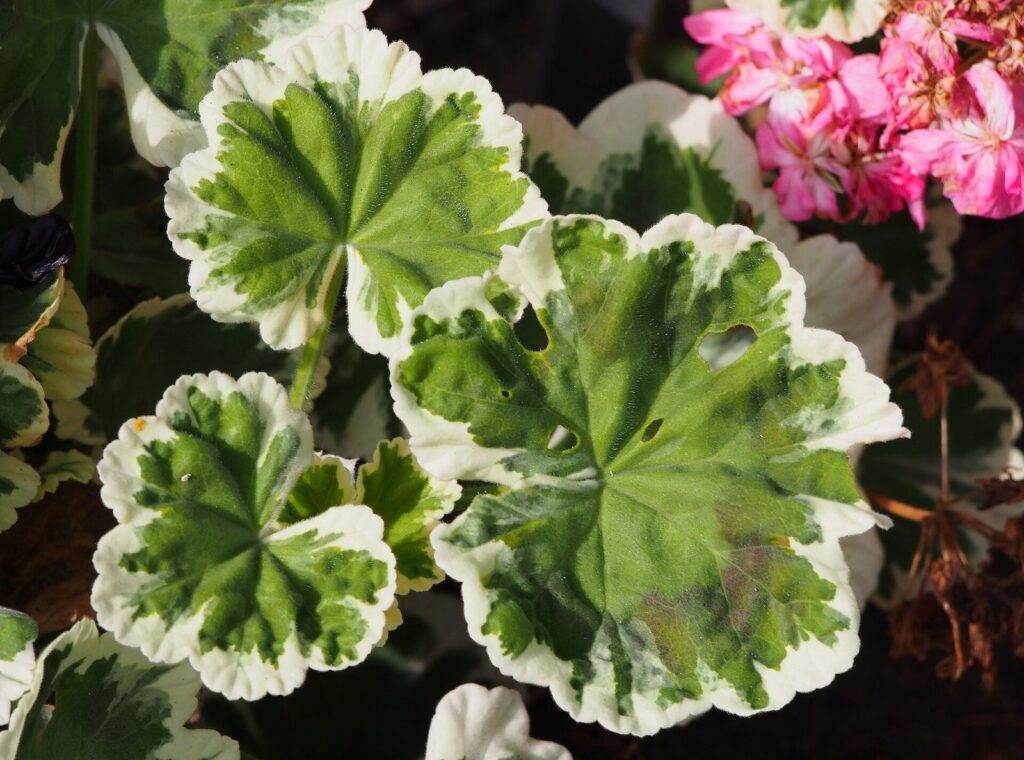
Periclinal chimeras, where a whole layer is mutated, are the most stable form. In sectorial chimeras, only a wedge of the tip carries the mutation. These tend to split into all-green or all-white shoots as the plant grows.
Structural variegation: air under the surface
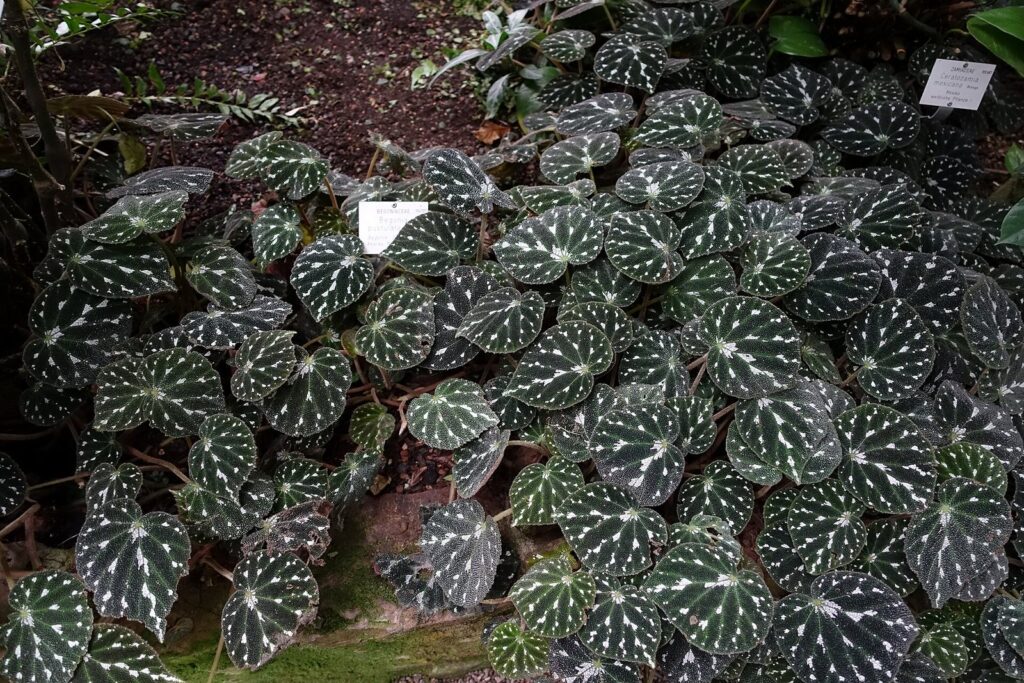
Some pale patches contain plenty of chlorophyll. In silver-marked Begonia, air spaces between leaf cells bounce light back out and make the surface look pale. Researchers led by Chiou-Rong Sheue found the same air-space mechanism in seven Begonia taxa.
Pattern genes
Some patterns are written into the plant’s DNA and repeat on every leaf. UF/IFAS horticulture agent Ralph Mitchell notes that variegation “can be natural and manifest stable patterns via selected genetics.” These plants do not revert because no unstable cell layer is involved.
Viruses
A small group of ornamentals owe their markings to infection. A 2012 review in Plant Disease by Rodrigo Valverde and colleagues described ornamentals whose prized patterns come from viruses. The best-known case is flowering maple (Abutilon) infected with Abutilon mosaic virus.
| Type | What causes the pale zone | Chlorophyll in pale zone | Stability |
|---|---|---|---|
| Chimeral | Mutated cell layer in the shoot tip | Little or none | Varies; reversion common |
| Structural (air-space) | Air gaps reflect light | Present | Stable |
| Pattern gene | Inherited pigment pattern | Varies by pattern | Stable, repeats on every leaf |
| Viral | Infection disrupts chloroplasts | Reduced | Spreads by grafting and insects |
How variegated leaves perform photosynthesis
Pale tissue without chloroplasts cannot photosynthesize, so it lives off sugar from the green parts. A 2023 study of the zonal pelargonium ‘Frank Headley’ measured this directly. The white margins held less sugar, and the authors called them a carbon sink that depends on green tissue.
The cost depends on the mechanism. In the 2012 Begonia study, the efficiency of photosystem II did not differ significantly between silver and green areas. In the chlorophyll-deficient climbing fig Ficus pumila ‘Sonny’, the pale zones had lost almost all photosynthetic function.
Why it works
A leaf that is half white has roughly half the working surface of an all-green leaf. The plant compensates only if it receives more light per square inch.
That is why heavily variegated cultivars grow slowly and stall in dim corners. The white areas still breathe and consume sugar, so they cost energy while producing none.
“The white areas of variegated leaves don’t contain any chlorophyll.”
Royal Horticultural Society, How plants use light to grow
Light, reversion, and keeping the pattern
The Royal Horticultural Society advises that variegated plants grow more slowly and need a bright spot. It adds that a plant reverting to all-green is often a sign that light levels are too low. Bright, indirect light suits most variegated houseplants, since direct midday sun can scorch the pale tissue.
Reversion is the main risk for chimeral plants. All-green shoots carry more chlorophyll, so they outgrow the variegated ones and can take over within a season. A few habits keep the pattern intact:
- Cut all-green shoots back to the point where they emerge, as soon as you see them.
- Give the plant the brightest indirect light you have, especially in winter.
- Propagate from stem cuttings that include variegated leaves and the node beneath them.
- Avoid propagating chimeras from leaf cuttings, since new plants may form from a single cell layer.
Caution
The RHS snake plant guide warns that leaf cuttings from variegated cultivars tend to produce plants that revert to green. To keep a yellow-edged snake plant true, divide the clump instead.
Every variegated leaf trades some energy for its looks, and the size of that trade varies by cause. Identify the mechanism behind the pale zones first. Then you can judge how much light the plant needs and how hard it will work to keep its pattern.
Questions & observations