

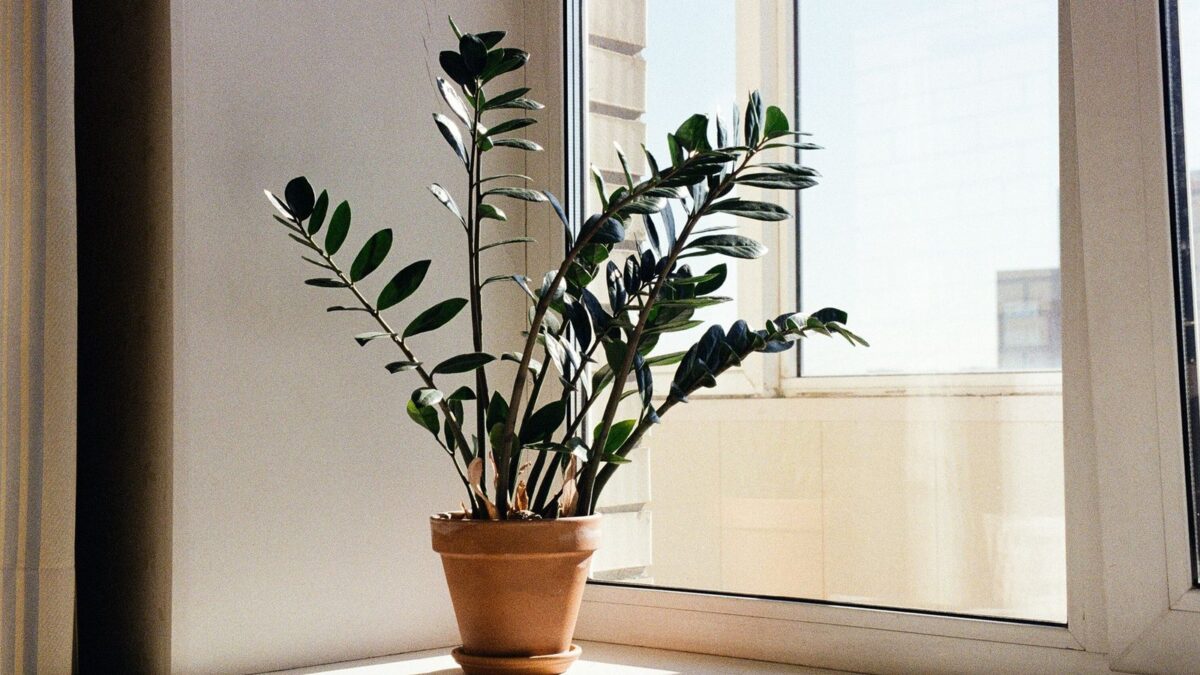
Phototropism is a plant’s habit of bending its growth toward or away from light. A pothos that tilts toward the glass is showing it. The lean is a growth response, not a sign of weakness.
The bend happens because cells on the shaded side of the stem grow longer than cells on the lit side. Light powers photosynthesis inside the leaves, so a stem that steers its leaves toward a window feeds the whole plant.
What is phototropism?
Phototropism is directional growth in response to light coming from one side. A 2014 review in The Plant Cell by Emmanuel Liscum and colleagues defines it precisely.
“Phototropism, or the differential cell elongation exhibited by a plant organ in response to directional blue light, provides the plant with a means to optimize photosynthetic light capture.”
Liscum et al., The Plant Cell, 2014
Two details in that definition matter for houseplant owners. The response is driven by blue light, and it works through uneven cell stretching rather than the swelling hinge cells that fold a prayer plant’s leaves at night.
How phototropism works inside a stem
The process runs in three stages: the plant detects light, moves a hormone, and then grows unevenly. Each stage happens in a different place.
Phototropins read the direction of blue light
The sensors are proteins called phototropins. John Christie’s 2007 review in the Annual Review of Plant Biology notes that Arabidopsis carries two, phot1 and phot2. The PHOT1 gene was first isolated in 1997.
The same receptors also control stomatal opening and chloroplast movement inside leaves. Christie describes all of these responses as ways to improve photosynthetic efficiency.
Auxin collects on the shaded side
Once the light direction registers, the plant redistributes the growth hormone auxin across the stem. Liscum’s team describes light signals steering the cell-to-cell movement of auxin until one side holds more than the other.
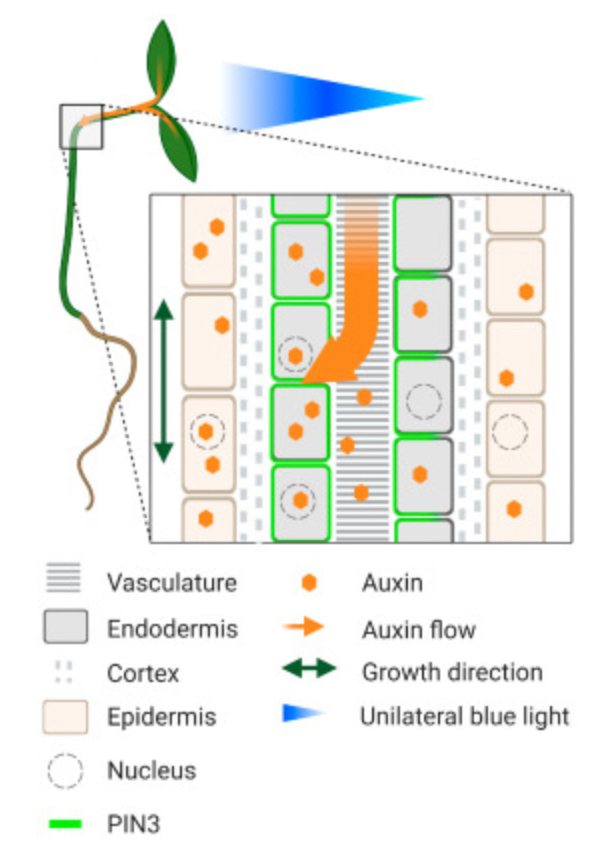
Auxin promotes cell elongation, and the extra dose sits on the shaded flank. That flank stretches faster than the lit one, and the stem curves toward the window.
Why it works
A stem cannot pivot like a joint, so it bends by growing more on one side. Picture a strip of paper glued to a slightly longer strip: the pair curls toward the shorter one. The lit side of the stem plays the shorter strip.
Darwin’s canary grass and Went’s oat tips
The mechanism was worked out over roughly half a century. The main steps are clear, though sources differ on one small detail.
- 1880: Charles Darwin, assisted by his son Francis, publishes The Power of Movement in Plants. They shade the tips of canary grass (Phalaris canariensis) and oat seedlings with tin-foil caps, and the lower stems stop bending.
- Spring 1926: Frits Went collects a growth substance from cut oat coleoptile tips in small blocks. A block placed on one side of a decapitated stump makes it curve.
- 1928: Went’s doctoral thesis appears. His oat coleoptile technique becomes the standard bioassay for auxin.
Darwin’s conclusion still holds up as a plain description of the response. He wrote it after shading only the tip and watching the lower stem stay straight.
“We must therefore conclude that when seedlings are freely exposed to a lateral light some influence is transmitted from the upper to the lower part, causing the latter to bend.”
Charles Darwin, The Power of Movement in Plants, 1880
Arthur Galston and Thomas Sharkey wrote the National Academy of Sciences memoir of Went. They call the 1926 result “the first unequivocal demonstration” of auxin in plant tissue.
The same memoir says Went used gelatin blocks. Most textbook accounts say agar, so treat the block material as an unsettled detail.
Positive and negative phototropism
Shoots usually grow toward light, which botanists call positive phototropism. Some organs grow away from it, which is negative phototropism.
| Organ or plant | Direction | What it gains |
|---|---|---|
| Most shoots and leaf stalks | Toward light | More light on the leaves |
| Roots of Arabidopsis and rice | Away from light | Stay in the soil, where water is |
| Juvenile Monstera gigantea shoots (skototropism) | Toward the darkest sector | Find a tree trunk to climb |
| Creeping shoots of English ivy | Away from light | Find a host tree |
Donald Strong and Thomas Ray studied Monstera gigantea seedlings in a 1975 paper in Science. The seedlings grew toward the darkest sector of the horizon, which in a forest is usually a tree.
Strong and Ray named this skototropism, growth toward darkness, and set it apart from simple negative phototropism. English ivy shows the classic form. A 2023 study in Tree Physiology by Tomasz Wyka confirmed that ivy seedlings and creeping shoots bend away from light.
What a leaning houseplant tells you about light
A lean shows where the light comes from, and a strong lean shows how little of it there is. Illinois Extension horticulturist Richard Hentschel describes the symptoms of low light. Plants grow “small leaves and long thin stems reaching for more light.”
Indoor light falls off quickly with distance from glass. Hentschel puts a south-facing window at about 300 foot-candles and an east or west window at about 150. Our guide to how much light green leaf plants get indoors and outdoors compares those numbers with full sun.
- Mild lean, normal leaf size: the plant gets one-sided light but enough of it. Rotation is all it needs.
- Strong lean, small new leaves: the light is too weak. Move the pot closer to the window or add a grow light.
- Long gaps between leaves: the plant has stretched for light. Those stretched stems will not shorten again.
How often to rotate pots
Rotation evens out the light each side of the plant receives. It does not stop phototropism, but it keeps the bend from building in one direction.
Turn the pot each time you water
The New York Botanical Garden’s plant information service recommends rotating each time you water. For most houseplants, that means roughly once a week. NDSU Extension horticulture agent Carrie Knutson used the same schedule on a lopsided plant of her own.
A quarter turn at each watering is the common routine. Turn in the same direction every time so each side gets a full stint facing the window.
Straightening a plant that already leans
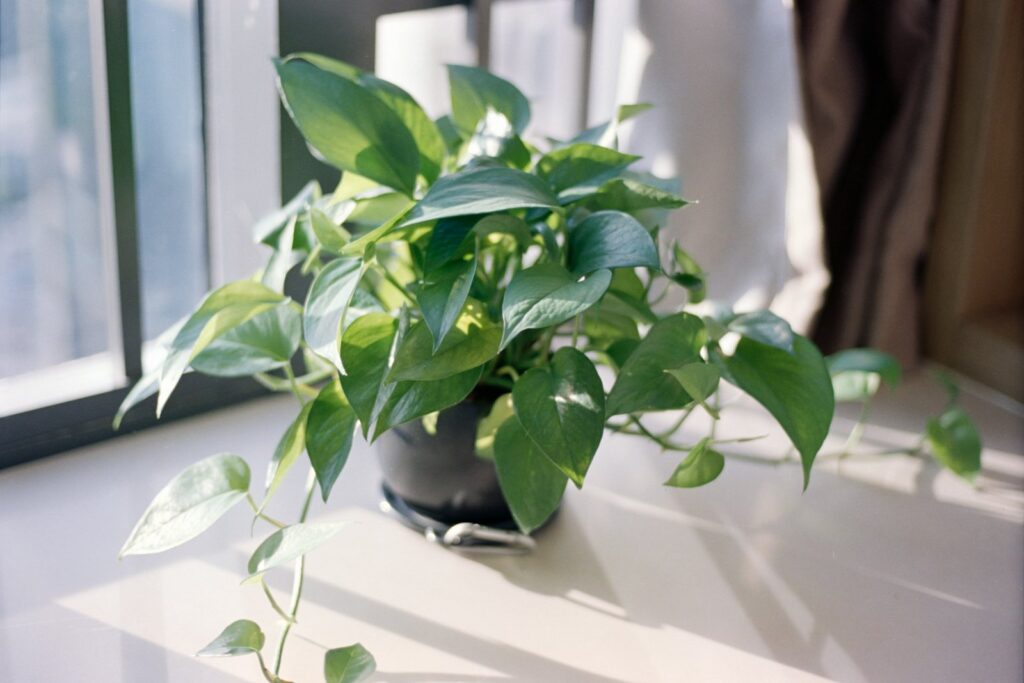
A plant with a strong lean needs a different first step. NYBG advises turning the bent side away from the light and waiting until the stems straighten up. Then the regular weekly rotation can start.
Caution
Woody stems respond slowly or not at all. A croton, ficus, or dracaena with an old bend may need a stake or careful pruning. Rotation shapes new growth, not wood that has already hardened.
Leaf plants show phototropism most clearly, since their display depends on leaf position. Our introduction to foliage plants and their main groups covers which ones handle low light.
A plant that leans hard every week is asking for a brighter spot. Turning the pot only answers half the question.

Questions & observations