

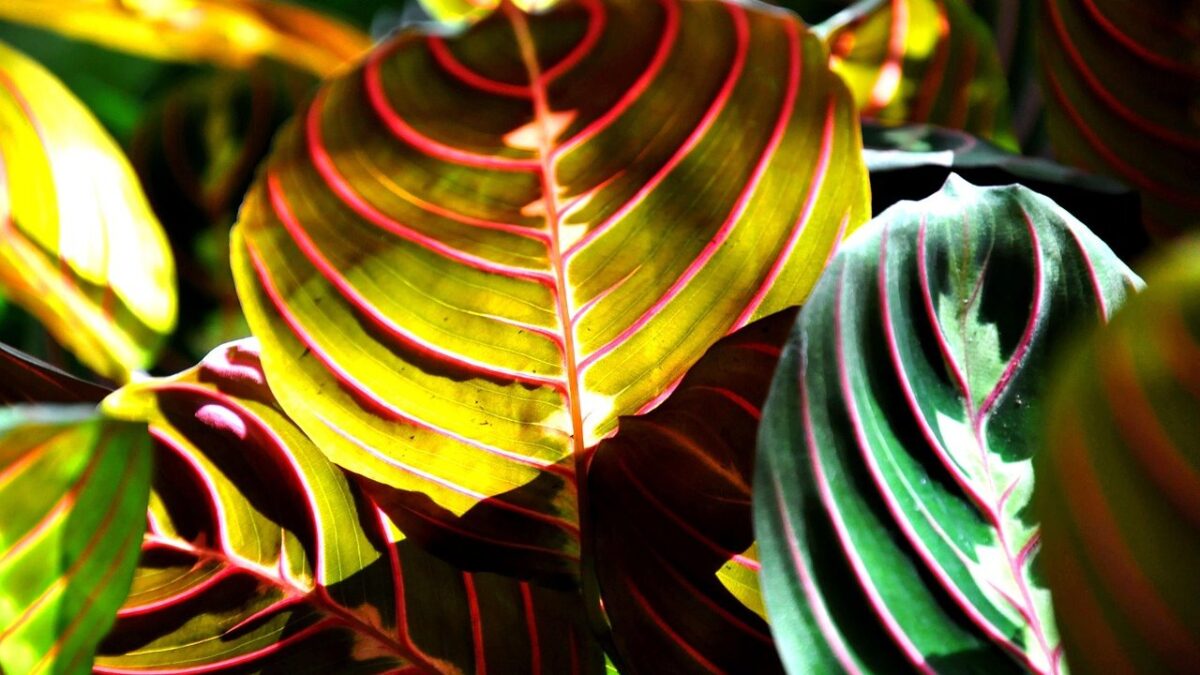
The prayer plant is Maranta leuconeura, a low, patterned houseplant from Brazil that lifts its leaves upright every evening. A small hinge of motor tissue at the top of each leaf stalk, the pulvinus, drives that daily movement.
The species belongs to Marantaceae, the arrowroot family. Our guide to the main groups of foliage plants covers the family in one short section. This profile covers the name, the leaf movement, the varieties, and the care that keeps the pattern sharp.
Prayer plant naming and taxonomy
Plants of the World Online accepts Maranta leuconeura É.Morren, published in 1874. Kew gives its native range as central and eastern Brazil, with introduced populations in Colombia and the Gulf region of Mexico.
NC State Extension lists a crowd of common names for this one species. They include herringbone plant, rabbit tracks, cathedral windows, and red-veined prayer plant. Most of them describe a leaf pattern rather than a separate plant.
The Calathea split
Prayer plants share shelf space with calatheas, and the two were long confused in the trade. In 2012, Finn Borchsenius and colleagues showed that Calathea as then defined was not one natural group. Their paper in Systematic Botany revived the genus Goeppertia and made 246 new name combinations.
Many well-known houseplant calatheas, such as the peacock plant, now carry Goeppertia names in botanical databases. Maranta itself was not affected, so a true prayer plant keeps its name.
When “prayer plant” means another plant
The common name drifts. The ASPCA’s “Prayer Plant” entry is filed under the scientific name Calathea insignis. It also lists “Maranta” and “Red Veined Prayer” as alternate names.
That is a database labeling quirk, and it matters when you look up pet safety. Check the botanical name on the plant tag before trusting any common-name search.
Why do prayer plant leaves fold at night?
Prayer plant leaves fold at night because the pulvinus at the top of each leaf stalk changes shape on a daily cycle. NC State Extension describes the result. By day the leaves sit parallel to the ground, and at night they rise to a perpendicular “prayer” position.
Leaves close upward at night in a manner resembling praying hands, hence the common name of prayer plant.
Missouri Botanical Garden
The pulvinus is a family trait. Flora of North America describes it as a zone of specialized cells atop the petiole that controls leaf movement. It is often a different color from the rest of the stalk.
Why it works
A pulvinus bends when motor cells on one side swell with water while cells on the other side shrink. In the legume Albizzia julibrissin, Ruth Satter and Arthur Galston linked this to potassium moving in and out of motor cells. Light and an internal rhythm set the timing, and water follows the potassium.
That potassium model comes from legume research. We found no comparable ion measurements for Maranta pulvini, so treat it as the best-supported explanation by analogy.
What the movement tells you
Botanists call sleep movements like this nyctinasty. A healthy prayer plant should raise its leaves in the evening and lower them in the morning light.
A plant that stops moving is worth a closer look. The hinge runs on light cues and water pressure, so check for a dark corner or a dried-out root ball first.
Common prayer plant varieties
Growers sell several forms of Maranta leuconeura, and the names are messier than the labels suggest. NC State treats var. erythroneura and var. kerchoveana as former names. Missouri Botanical Garden still profiles var. erythroneura as a variety.
Red-veined prayer plant
This is the form most stores sell, with a dark olive leaf, a pale feathered center, and bright red veins. Missouri Botanical Garden profiles it as Maranta leuconeura var. erythroneura, growing 12 to 18 inches tall and wide.
Kerchoveana, or rabbit tracks
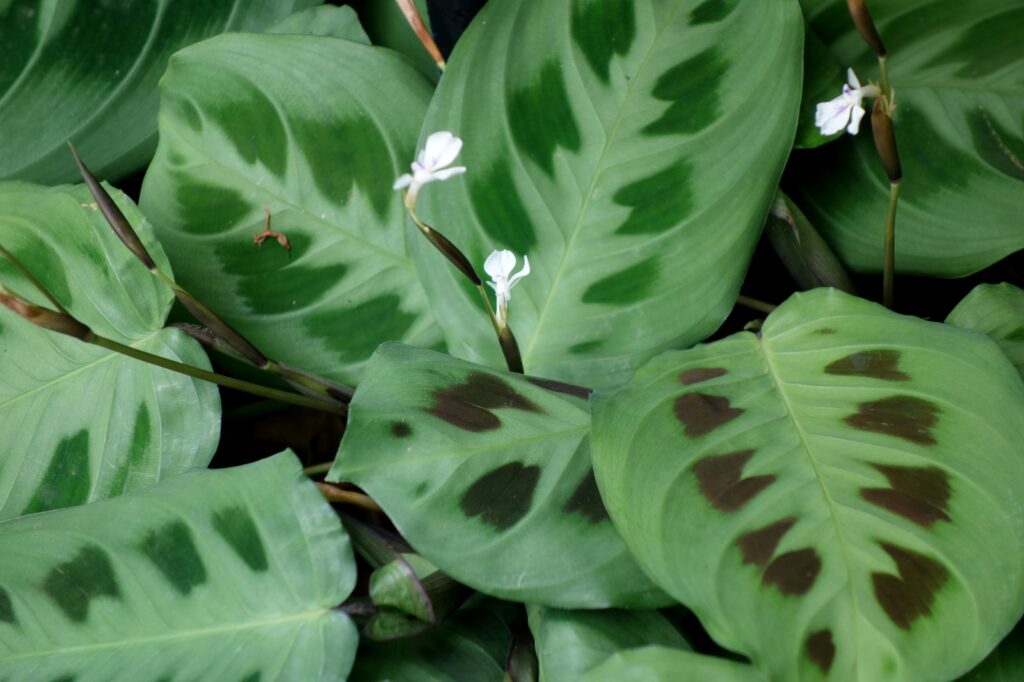
Kerchoveana has plain green leaves marked with dark blotches between the veins, the “rabbit tracks” of its common name. It has no red veining, and the blotches fade toward green on older leaves.
Lemon Lime
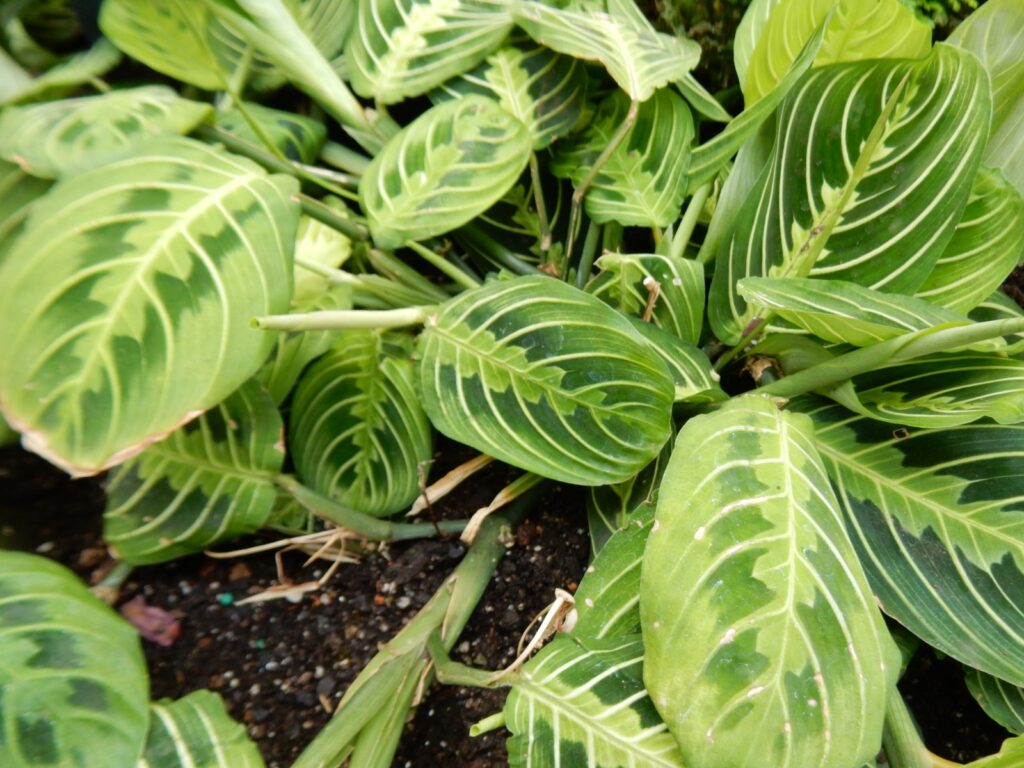
‘Lemon Lime’ replaces the red with bright yellow-green veining on a lighter leaf. NC State lists it among the cultivars of the species, together with ‘Fascinator Tricolor’ and ‘Silver Band’.
All three fit a mixed shelf of easy tropical houseplants for an indoor jungle. Set them low at the front, where the leaf pattern is easy to see.
Prayer plant care that keeps the pattern
Prayer plants want warmth, steady moisture, and light without direct sun. The targets below come straight from extension and botanical-garden profiles.
| Factor | Target | Source |
|---|---|---|
| Light | Bright, indirect; no direct sun | NC State Extension |
| Temperature | Above 60°F (16°C) | Missouri Botanical Garden |
| Water | Evenly moist in the growing season, drier in winter | NC State Extension |
| Humidity | High; humidifier or pebble tray | NC State Extension |
| Hardiness | USDA Zones 11–12 (MBG) or 11a–11b (NC State) | Missouri Botanical Garden, NC State Extension |
Too much sun bleaches the leaf colors, Missouri Botanical Garden warns. An east window or a spot a few feet back from a bright south window keeps the pattern dark.
Water quality
Prayer plants react to what is in the water, along with how much of it they get. A University of Maryland Extension specialist notes that marantas are sensitive to municipal tap water additives such as fluoride.
- Water when the top inch of mix feels dry during spring and summer.
- Switch to purified water if leaf tips brown on tap water.
- Empty the saucer so the roots never sit in drained water.
- Skip misting, which the same specialist says can spread leaf disease.
Field note
Missouri Botanical Garden lists tip browning among the common problems of this species. Water quality and dry air can both cause it, so change one factor at a time and judge by the new leaves.
For winter dryness, prayer plants follow the same humidity and temperature routine as other humid tropical plants. A humidifier beats a spray bottle for this species, and a young plant also suits a tall glass terrarium.
Prayer plants and pets
The ASPCA rates its prayer plant entry as non-toxic to dogs, cats, and horses. Because that entry carries the Calathea insignis name, the rating is best read as covering the common-name group, which includes Maranta.
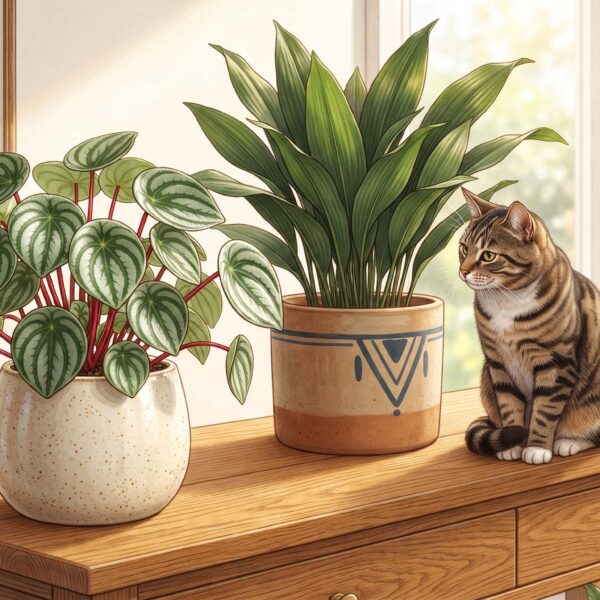
Non-toxic does not mean edible. Any leaf eaten in quantity can upset a cat’s stomach, so keep the plant where nibbling does not become a habit.
The next time your prayer plant stays flat after dark, check the light and the water before anything else. The leaves are giving you a nightly report on how the plant is coping.


Questions & observations