

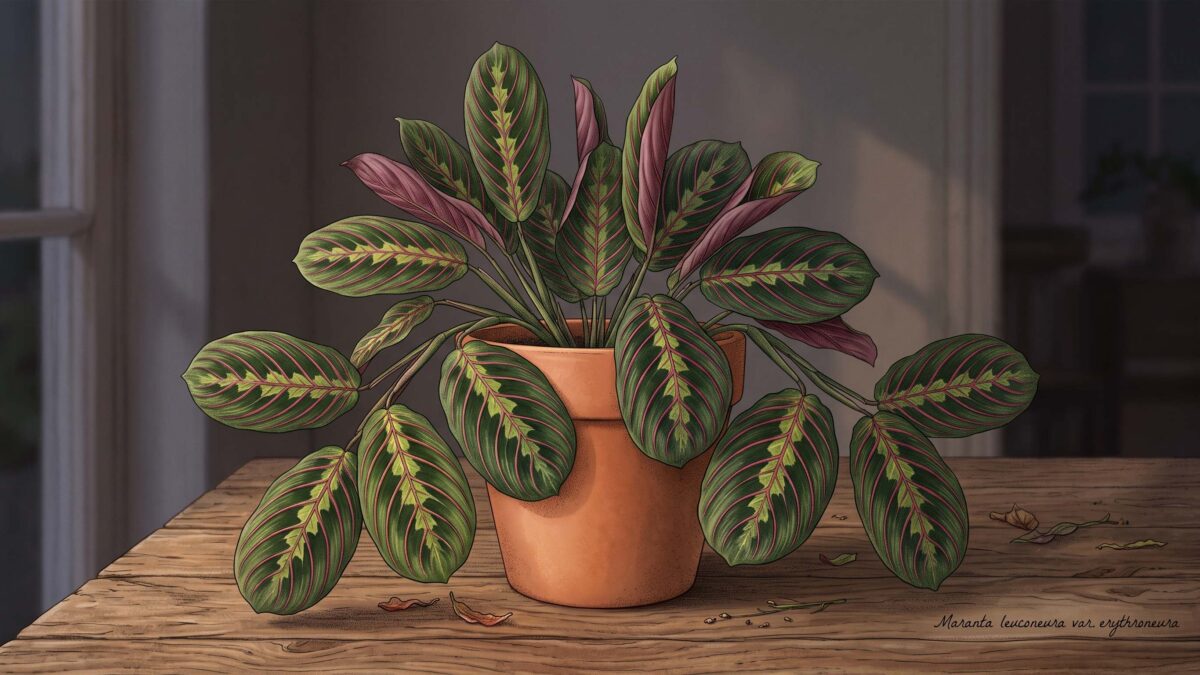
Why do prayer plants fold their leaves at night? They raise their blades through nyctinasty, a daily rhythm driven by water pressure inside a swollen joint called the pulvinus at the base of each leaf. Unlike phototropism, which bends stems toward a window through cell growth, nyctinasty is a reversible hydraulic movement controlled by the plant’s internal circadian clock.
When a prayer plant stops raising its leaves after dark, it is usually signaling an early problem with soil moisture, air humidity, or light before the leaf margins ever turn brown.
What is nyctinasty in the arrowroot family (Marantaceae)?
Nyctinasty is the circadian opening and closing of plant organs—most noticeably leaves and leaflets—in response to the daily cycle of light and darkness. Because the movement does not rely on permanent cell elongation, a single leaf can fold upward and flatten out again hundreds of times over its lifespan.
In the arrowroot family (Marantaceae), nyctinastic movement is a signature trait shared by the genera most widely grown as foliage plants: Maranta, Goeppertia, Stromanthe, and Ctenanthe. Kew’s Plants of the World Online places Maranta leuconeura—the classic red-veined prayer plant—in wet tropical forests native to Brazil.
Many related prayer plants sold in garden centers as Calathea now belong to the genus Goeppertia following a 2012 taxonomic revision by Borchsenius and Suárez. Whether the nursery tag reads Maranta, Calathea, or Goeppertia, the anatomy that lifts the leaf at dusk works the same way.
How the pulvinus works as a hydraulic hinge
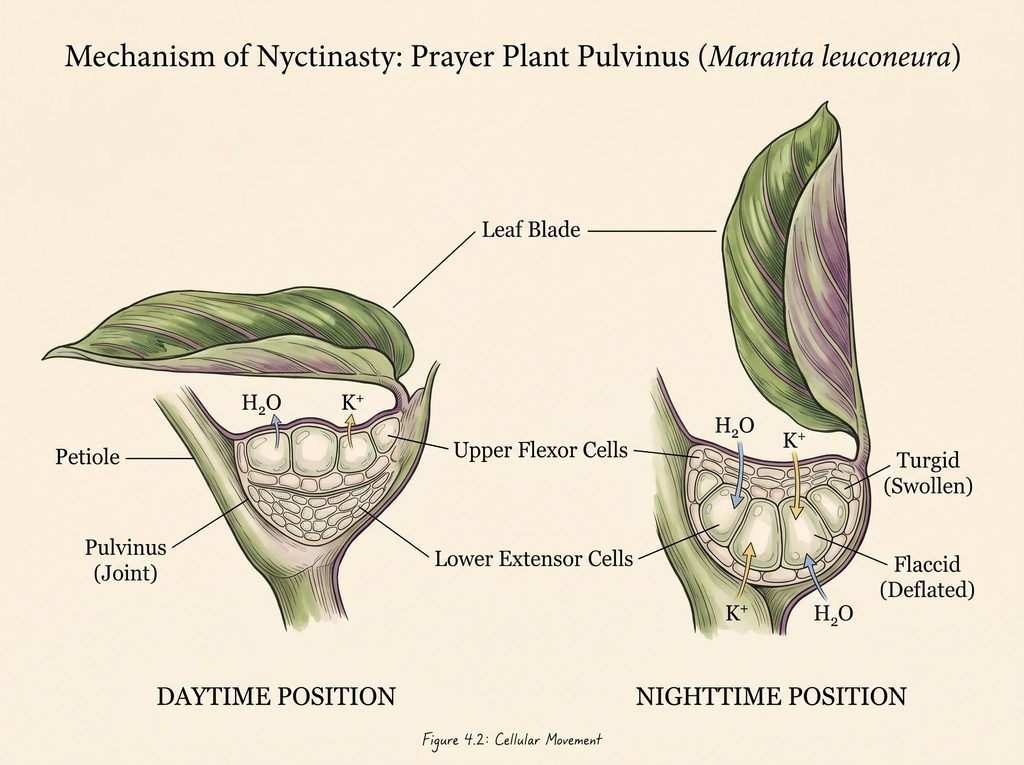
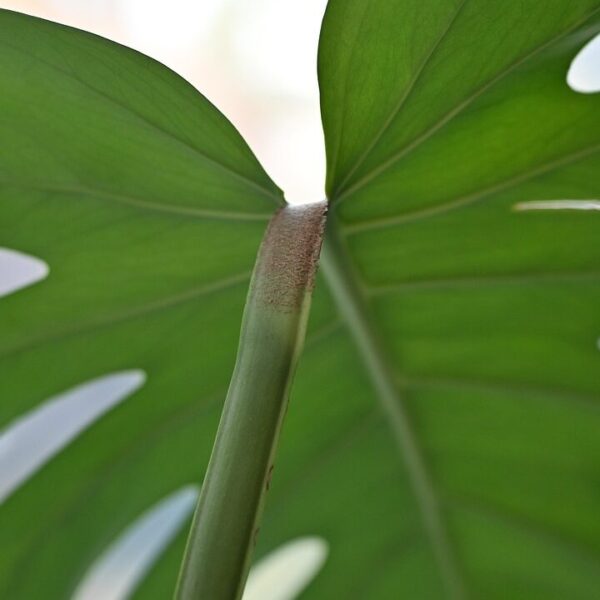
A prayer plant leaf does not curl or bend along the middle of its blade to pray. Instead, the entire blade pivots at the pulvinus, a firm, slightly swollen collar of tissue located at the top of the petiole right where it joins the leaf base.
Understanding how foliage leaves function makes the mechanism clear. Inside the pulvinus sit two opposing bands of thin-walled parenchyma cells known as motor cells:
- The extensor zone on the lower (abaxial) side of the joint.
- The flexor zone on the upper (adaxial) side of the joint.
The plant raises and lowers its leaves by pumping ions—primarily potassium (K+) and chloride (Cl-)—back and forth between these two zones:
- At dusk: Signals from the plant’s circadian oscillator and light-sensing phytochrome pigments trigger proton pumps in the cell membranes. Potassium and chloride ions move out of the upper flexor cells and accumulate inside the lower extensor cells.
- Water follows osmotically: Water flows across the cell membranes into the ion-rich lower extensor cells, inflating them with turgor pressure while the upper flexor cells lose water and relax. Because the lower side of the hinge swells and the upper side compresses, the leaf blade is pushed nearly vertical.
- At dawn: Blue light receptors and the internal clock reverse the ion flow. Water refills the upper flexor cells, the lower extensor cells relax, and the blade settles back into a horizontal position to capture morning light.
Why It Works: Because the pulvinus operates on turgor pressure rather than muscle or wood, a prayer plant can only move its leaves when its cells are fully hydrated. Any drop in root water uptake or spike in leaf transpiration immediately weakens the hinge.
Evolutionary reasons tropical understory plants fold their leaves
Botanists have studied nyctinasty since Charles Darwin measured leaf angles in his 1880 book The Power of Movement in Plants. Field studies on tropical understory herbs point to three practical advantages:
- Shedding night condensation and rain: In humid forest understories, water standing on a flat leaf overnight encourages fungal spores and epiphytic algae. Tilting the blade vertically lets moisture run off the tip.
- Conserving leaf warmth: Horizontal leaves radiate heat toward the night sky faster than vertical leaves grouped together. Folding upward creates a slightly warmer boundary layer around the crown.
- Reducing nocturnal herbivory: Vertical leaves cast a smaller horizontal profile against the forest floor and expose leaf-chewing insects to nocturnal predators.
Troubleshooting: Why your prayer plant stopped moving
When a Maranta or Goeppertia stops folding at night—or stays locked upright through the afternoon—the cause almost always traces back to water balance or light cues.
| What You See on the Plant | Primary Cause | How to Fix It |
|---|---|---|
| Leaves stay flat and limp through the night | Underwatering or root rot | Motor cells lack the water needed to build turgor. Check the potting mix 1 inch down; water thoroughly if dry, or inspect roots if the soil is soggy. |
| Leaf edges curl inward like straws instead of folding up | Dry indoor air or bright direct sun | Thin blades lose water faster than petioles can supply it. Manage it like other humid tropical plants by keeping relative humidity between 50% and 65%. |
| Leaves barely rise at night; stems look normal | Room lights left on late at night | Artificial light after dusk confuses phytochrome signaling. Give the plant at least 8 to 10 hours of uninterrupted darkness each night. |
| Leaves stay pointed upward during the day | Excess light intensity | Raising blades in daytime is a light-avoidance response (paraheliotropism) to prevent chlorophyll bleaching. Move the pot back into medium indirect light (75–150 foot-candles). |
| Lower leaves stop moving and turn pale yellow | Petiole senescence or chlorosis | Old leaves lose hydraulic conductivity before they drop. If several leaves yellow at once, check our guide on why plant leaves turn yellow. |
Care practices that keep the daily movement strong
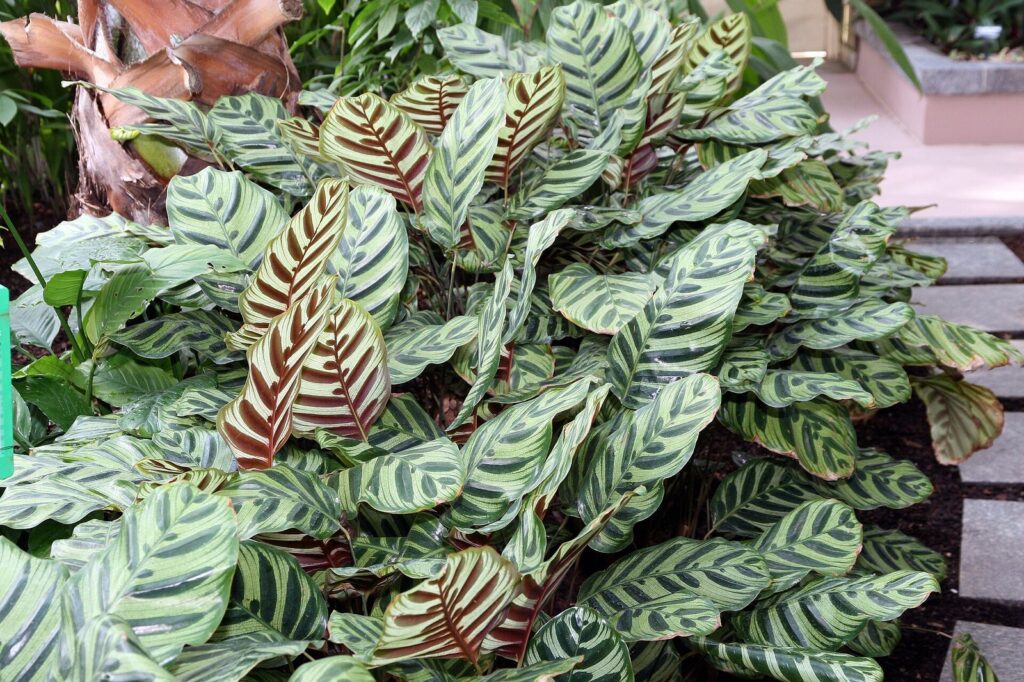
Keeping Maranta leuconeura and its relatives active indoors comes down to matching the steady conditions of a forest floor. NC State Extension and the Missouri Botanical Garden rate Maranta leuconeura for USDA Zones 11 to 12 outdoors, which makes it a year-round container plant in almost every temperate climate.
- Give it medium indirect light (75–150 foot-candles): An east-facing window or a spot four to six feet back from a bright south or west window fuels ion transport without scorching the thin epidermis.
- Keep the root zone evenly moist, never waterlogged: Water when the top inch of mix feels lightly damp. Letting the pot bone-dry collapses turgor in the pulvinus within hours.
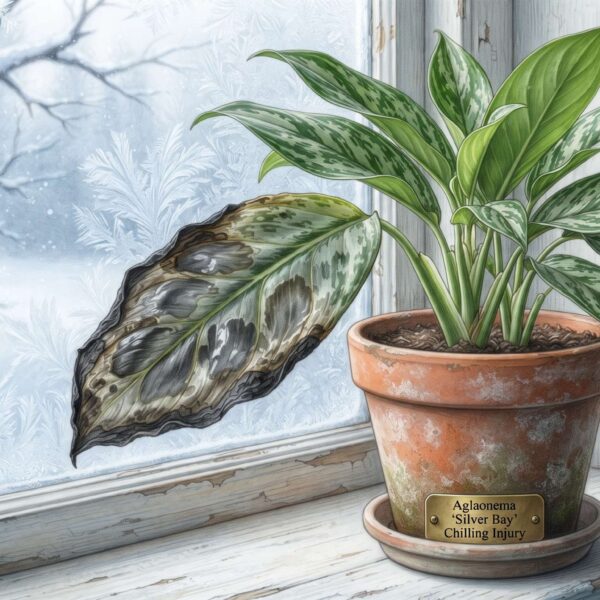
- Avoid cold drafts and sudden chills: Keep temperatures between 65°F and 80°F (18°C–27°C). Cold window drafts below 55°F slow membrane transport and cause chilling injury on the leaves.
- Group plants to buffer dry winter air: Clustering prayer plants with other tropical houseplants—or planting smaller cultivars inside closed terrarium ideas—keeps the boundary layer humid enough for the pulvinus to work effortlessly every evening. Because Maranta and Goeppertia are also pet-safe foliage plants, they can sit on low tables without risk to cats or dogs.
Questions & observations