
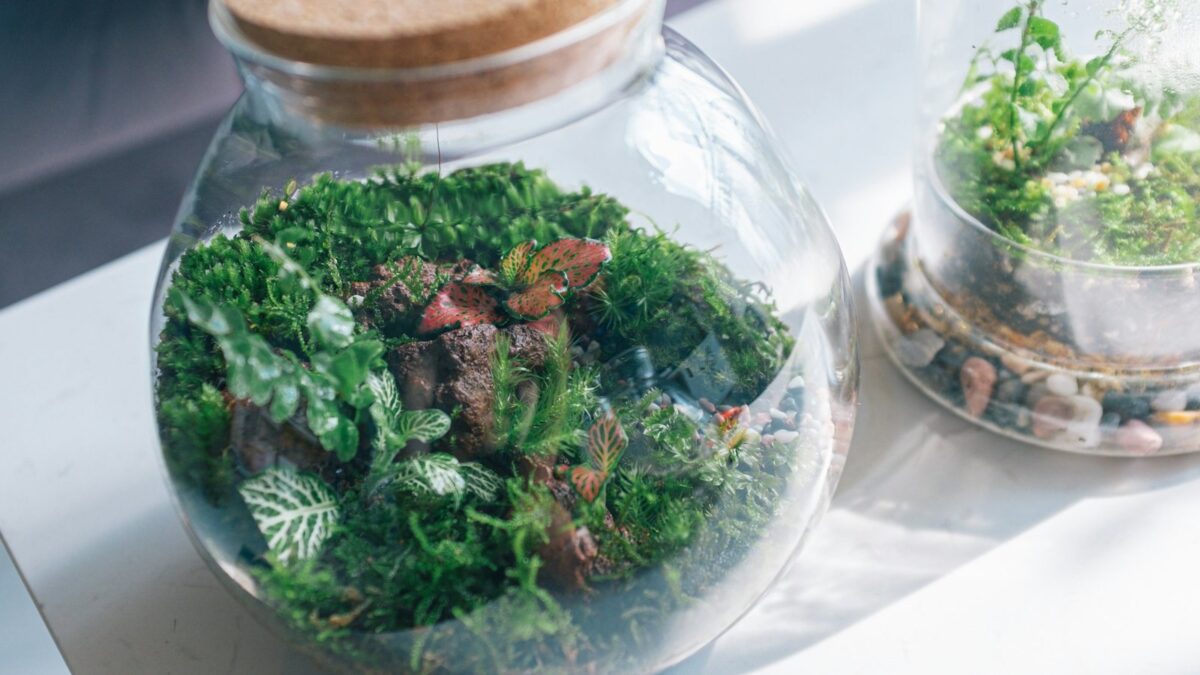
The best terrarium ideas start with leaves, because small, slow-growing foliage plants handle the steady humidity of a closed jar. Nerve plant, button fern, and spikemoss are reliable starters. Flowers fade and rot in that still air.
Every layout below uses foliage plants grown for their leaves, matched to a lidded jar or an open bowl. Each idea comes with a plant list, a container size, and a light position.
Why leaves outlast blooms under glass
The Royal Horticultural Society advises against flowering plants in a closed terrarium. Each time you lift the lid to remove spent blooms, you disturb the moisture balance the jar depends on.
Foliage plants avoid that problem. Many of the best candidates come from rainforest floors, where they grow in shade and damp air. They behave like the humid tropical plants on a bathroom shelf, only smaller and slower.
Which plants work in a closed terrarium?
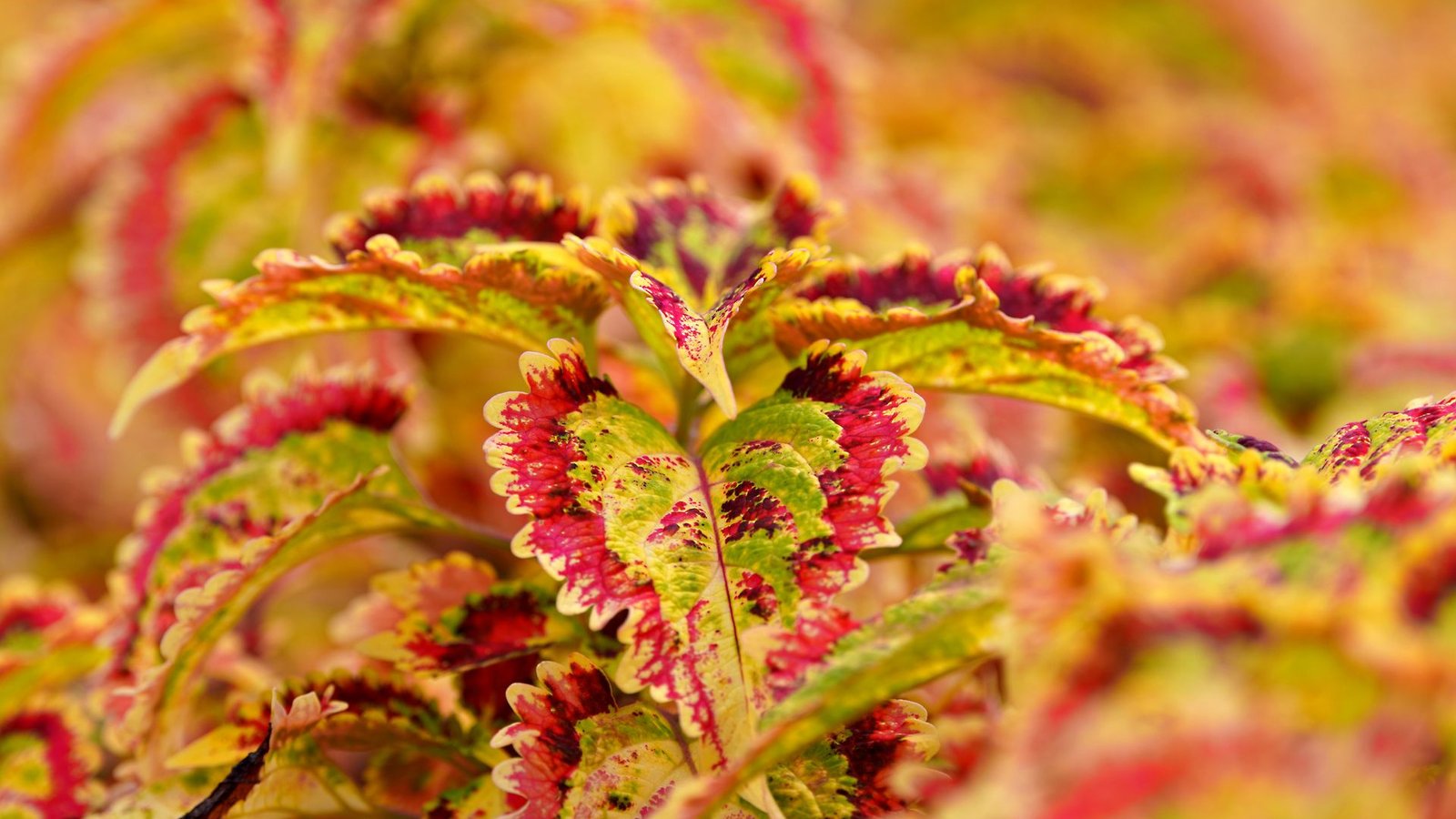
Plants for a closed terrarium are small, slow-growing, and comfortable in near-constant humidity. The RHS terrarium guide names peperomias, dwarf fittonias, polka dot plant, pileas, small-leaved ferns, earth stars, and Selaginella kraussiana. Mosses suit a sealed jar as well.
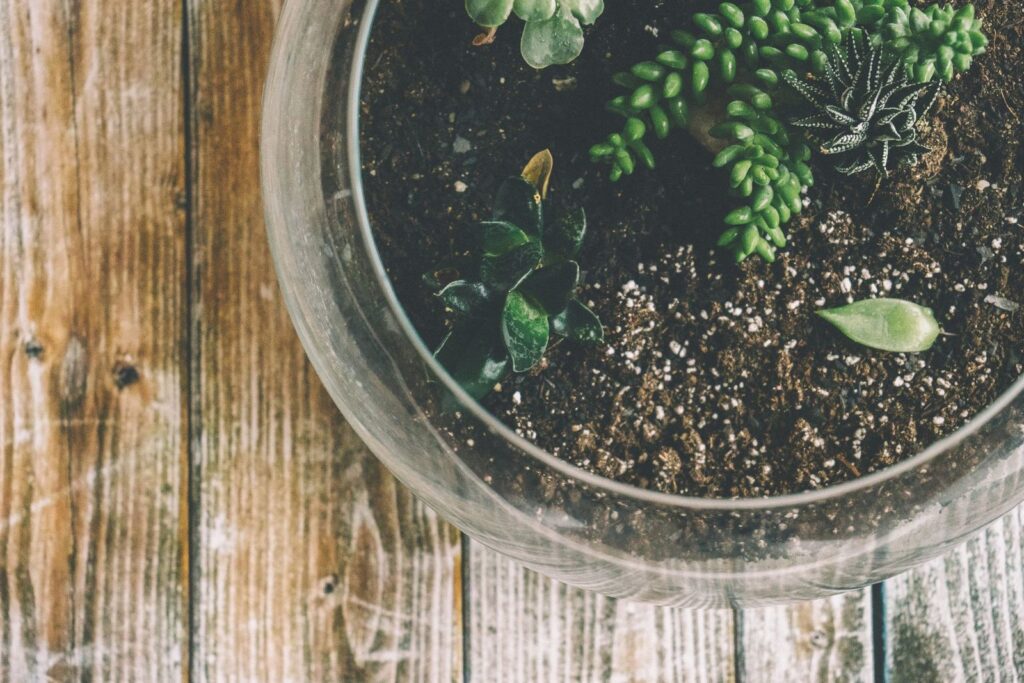
Succulents and cacti do not belong in this group. They rot in trapped moisture, so the RHS reserves them for open terrariums.
- Nerve plant (Fittonia albivenis): NC State Extension notes that dwarf forms suit terrariums, while full-size plants spread to about 18 inches.
- Spikemoss (Selaginella kraussiana): NC State calls high humidity and indirect light a must, and warns that it spreads fast.
- Button fern (Pellaea rotundifolia) and dwarf Boston fern (Nephrolepis exaltata ‘Fluffy Ruffles’): small-leaved ferns on the RHS list.
- Pileas: aluminum plant (Pilea cadierei), friendship plant (P. involucrata), and artillery plant (P. microphylla).
- Peperomias: watermelon peperomia (P. argyreia) and ripple-leaf cultivars of P. caperata.
Glass size and light set the limits
Size matters more than shape, and the RHS puts the ideal at about 12 inches wide and tall. A larger volume buffers moisture swings. Smaller jars work, but they hold fewer plants and fail faster when you overwater.
Light is the second limit, and plants under glass lean toward whichever side gets it. The RHS asks for six hours a day of bright, indirect light, such as a north- or east-facing window. Keep it out of direct summer sun, which turns a closed jar into an oven, and away from radiators.
If no window qualifies, a grow light fills the gap. NC State notes that nerve plants perform well under fluorescent lights.
Layering, and what the evidence actually supports
Most terrarium guides, including extension fact sheets, prescribe a stack of gravel, charcoal, a barrier, then substrate. Some of those layers rest on stronger evidence than others.
The gravel drainage layer
Clemson’s HGIC fact sheet 1457 recommends pea gravel in the base for drainage. The RHS suggests washed gravel or expanded clay. Both are long-standing advice.
Soil science complicates it. Washington State University horticulturist Linda Chalker-Scott cites decades of soil research on layered media. Water does not drain from fine mix into coarse gravel until the mix is saturated.
It is ironic that adding this material will induce the very state it is intended to prevent.
Linda Chalker-Scott, Washington State University Extension
In a terrarium, gravel does one useful thing. It gives excess water a visible place to collect once the substrate is already soaked. That makes it an overflow warning, so it cannot rescue a jar that is watered too heavily.
Activated charcoal
Clemson calls for a half-inch layer of horticultural charcoal “to keep the soil from developing a sour smell.” That advice is common, but we found no controlled study measuring charcoal’s effect inside a sealed terrarium. Treat it as optional.
Barrier, substrate, and moss
A layer of sphagnum moss or mesh keeps soil from sifting into the gravel. For the planting mix, the RHS suggests peat-free multipurpose compost blended with horticultural grit at about 4 to 1.
Clemson recommends at least 1.5 inches of soil. Drainage material plus soil usually fills about a quarter of the container.
Field note
Plant the tallest specimen toward the back, as Clemson advises. A low, coarse-leaved plant near the front then becomes the focal point.
Seven foliage terrarium ideas with plant lists
Each layout below matches plants that share the same light and moisture needs. Clemson warns that mixing a low-light plant with a high-light one leaves at least one of them struggling.
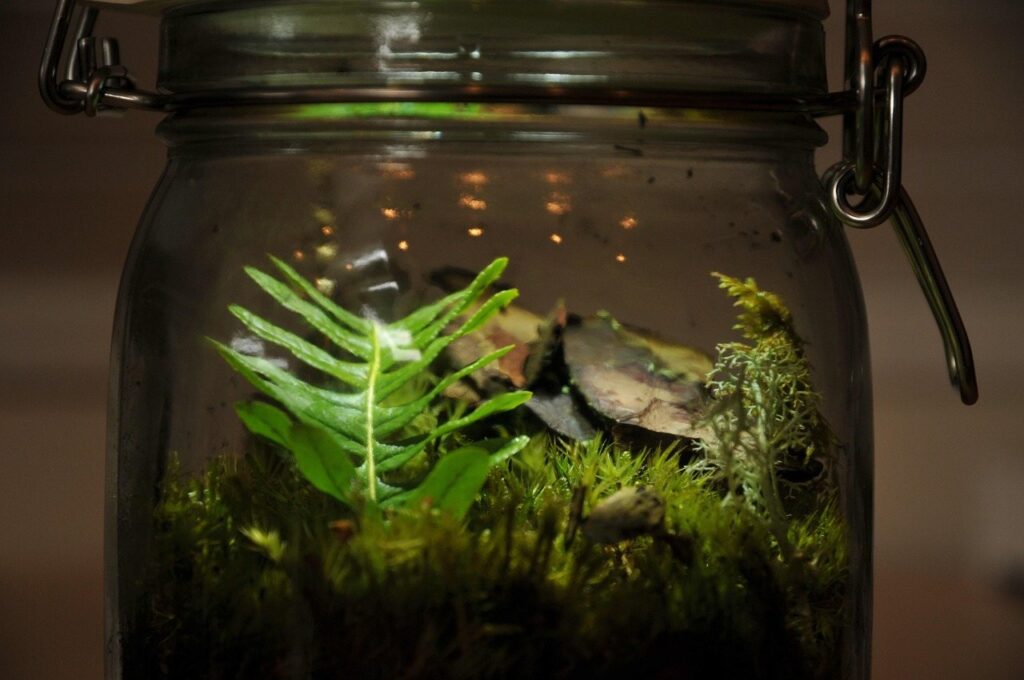
1. Fern and moss forest in a clip-top jar
This is the classic sealed jar. Set a small fern behind a mound of cushion moss. One stone adds a landmark.
- Button fern (Pellaea rotundifolia)
- Dwarf Boston fern (Nephrolepis exaltata ‘Fluffy Ruffles’)
- Cushion moss or live sphagnum
- One weathered stone or piece of cleaned wood
Clemson cautions that ferns can take over a terrarium. Choose dwarf forms and trim fronds that press against the glass.
2. Nerve plant carpet in a cookie jar
Fittonia’s red, pink, or white veins carry color without a single flower. A wide cookie jar about 10 inches across gives two or three dwarf plants room to creep.
- Dwarf nerve plants (Fittonia albivenis) in two vein colors
- Baby tears (Soleirolia soleirolii) as a low green filler
- A thin moss edging along the glass
3. Silver-leaf apothecary jar
Silver and gray foliage reads brighter behind glass. Pair an aluminum plant at the back with a watermelon peperomia in front.
- Aluminum plant (Pilea cadierei)
- Watermelon peperomia (Peperomia argyreia)
- Artillery plant (Pilea microphylla) as a fine-textured filler
4. Spikemoss hill in a bottle garden
The RHS notes that a wide-necked carboy or large bottle makes a striking bottle garden. Mound the substrate into a hill in the middle so the display reads from every side.
- Spikemoss (Selaginella kraussiana), plain green or ‘Aurea’
- Friendship plant (Pilea involucrata)
- Earth star (Cryptanthus) for a flat, starry rosette
Plant through the neck with chopsticks or a spoon taped to a cane. Expect to trim the spikemoss a few times a year.
5. Moss-only landscape
A moss terrarium needs the least care of any idea here. Build hills from the substrate, then press sheets of cushion moss over them.
- Cushion moss
- Live sphagnum
- A few small stones or a cleaned twig
The RHS warns never to collect moss from the countryside without the landowner’s permission. Garden moss or purchased moss is the safer source.
6. Tall vase with a parlor palm
A tall, narrow-mouthed container suits taller foliage. Clemson’s list for small-mouthed terrariums includes plants that would swamp a short jar.
- Parlor palm (Chamaedorea elegans), young and small
- Creeping fig (Ficus pumila) trailing across the base
- Prayer plant (Maranta) for patterned leaves
The parlor palm is also a floor-level anchor in an indoor jungle of beginner tropical houseplants. Under glass, buy the smallest plant you can find and expect to replace it once it touches the lid.
7. Open bowl of succulents
Open terrariums suit plants that dislike humid air. Use a wide glass bowl with a grittier mix. Give it more sun than any closed jar.
- Zebra haworthia (Haworthiopsis attenuata)
- Jade plant cuttings (Crassula ovata)
- A small echeveria rosette for a blue-gray contrast
Terrarium ideas compared at a glance
| Idea | Lid | Container width | Light |
|---|---|---|---|
| Fern and moss forest | Closed | 8 to 12 inches | Bright, indirect |
| Nerve plant carpet | Closed | About 10 inches | Medium to bright, indirect |
| Silver-leaf apothecary jar | Closed | 8 to 12 inches | Bright, indirect |
| Spikemoss hill | Closed or narrow neck | 12 inches or more | Bright, indirect |
| Moss-only landscape | Closed | Any size | Medium, indirect |
| Tall vase with parlor palm | Narrow neck | Tall, 6 to 10 inches | Bright, indirect |
| Open bowl of succulents | Open | 8 inches or more | Some direct sun |
Step-by-Step Guide to Building a Foliage Terrarium
These four steps build a closed jar terrarium of about one quart to one gallon. Prepare a clean glass jar with a lid, long tweezers or chopsticks, a spray bottle, and plants that already share the same light and moisture needs.
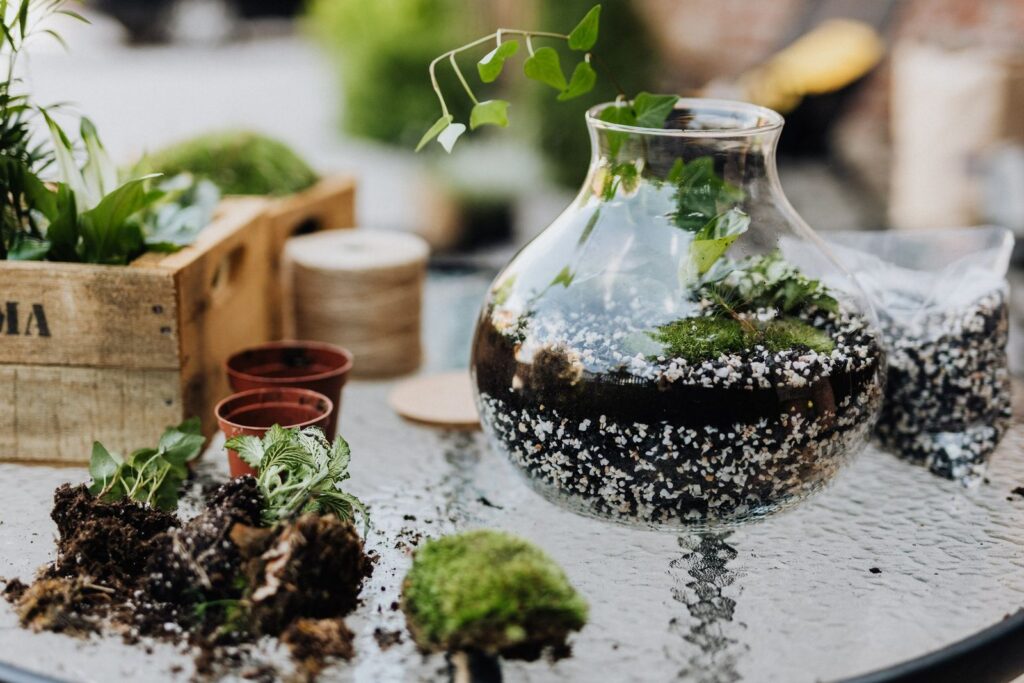
Step 1: Lay a gravel and activated charcoal base
Spread a layer of washed pea gravel about 1 inch deep across the bottom of the jar. As explained above, this layer can’t fix poor drainage. It acts as a reservoir that shows you when there’s too much water. Sprinkle a thin layer of activated charcoal on top if you have some. Then cover everything with a thin sheet of sphagnum moss or mesh so the soil doesn’t sift down into the gravel.
Step 2: Add a perlite and peat moss substrate
Mix two parts peat moss with one part perlite. Peat holds moisture, and perlite keeps the mix airy so roots don’t rot. If you’d rather avoid peat, coconut coir is an alternative that works the same way. Dampen the mix until it’s moist but doesn’t drip when squeezed. Spread it 2 to 3 inches deep, and shape low mounds if you want a landscape that isn’t flat.
Step 3: Arrange Fittonia and moss
Shake excess soil off the Fittonia’s roots so the plant fits the jar, then use chopsticks to set it into a small hole. Keep the leaves from touching the glass, because constant condensation makes leaf edges rot quickly. Once the main plants are in, press sheets of cushion moss over the bare substrate. Rinse the moss first and check it for small snails or insects so they don’t multiply inside the jar.
Step 4: Follow a balanced closed-watering rule
Right after planting, mist just enough that the leaves and the moss surface are damp. Water should never pool in the gravel layer. Close the lid and watch the jar for the first week:
- Fog stays thick all day: there’s too much water. Open the lid for a few hours until the glass clears.
- No mist at all for several days: the air is too dry. Add two or three sprays along the inside of the glass, then close the lid again.
- Light mist in the morning that fades by afternoon: the balance is right, and the jar can be left closed for a long time.
Leaves that start yellowing usually point to excess moisture. Read the pattern with the guide why do plant leaves turn yellow before changing how you water.
Reading condensation and other upkeep
The glass tells you when to water. The RHS notes that light condensation means the moisture is right, while no condensation means the jar is drying out. Heavy fog that never clears signals too much water.
A sealed jar may go months without water. Clemson’s fact sheet says a closed terrarium probably will not need watering for four to six months. When you water, use a mister and let the droplets run down the glass.
Caution
Remove yellowing or dead leaves as soon as you see them. The RHS lists yellowing leaves as the usual sign of overwatering, and decaying debris feeds mold in a closed jar.
Feeding is rarely needed. Clemson advises waiting at least a year after planting. If plants then look pale, use a water-soluble houseplant fertilizer at one-tenth the normal rate.
Some plants signal trouble in an unexpected direction. NC State notes that nerve plant leaves can wither when humidity runs too high. If fittonia looks limp in a fogged jar, crack the lid for a day.
Matching an idea to your room
A terrarium is a container problem first. If your brightest spot is a north window, start with the fern forest or the moss-only jar. A sunny sill points to the open succulent bowl instead.
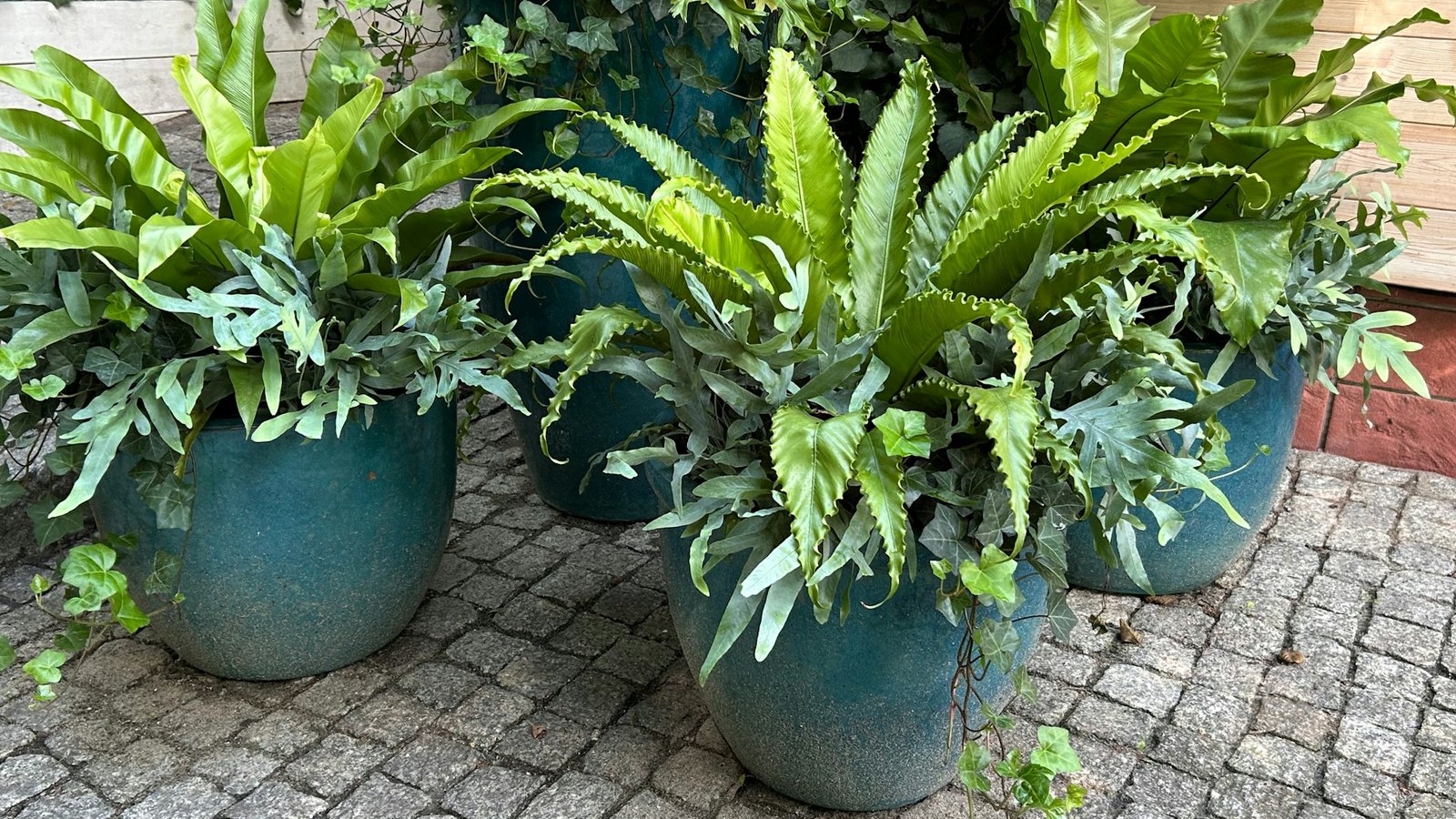
Outdoors, the pairing of thriller, filler, and spiller leaves carries over to shade plants for pots on a porch. Foliage carries the color in both settings.
Pick one jar, one light spot, and three plants that share the same needs. If the glass shows a light mist each morning, the system is working.
Questions & observations