

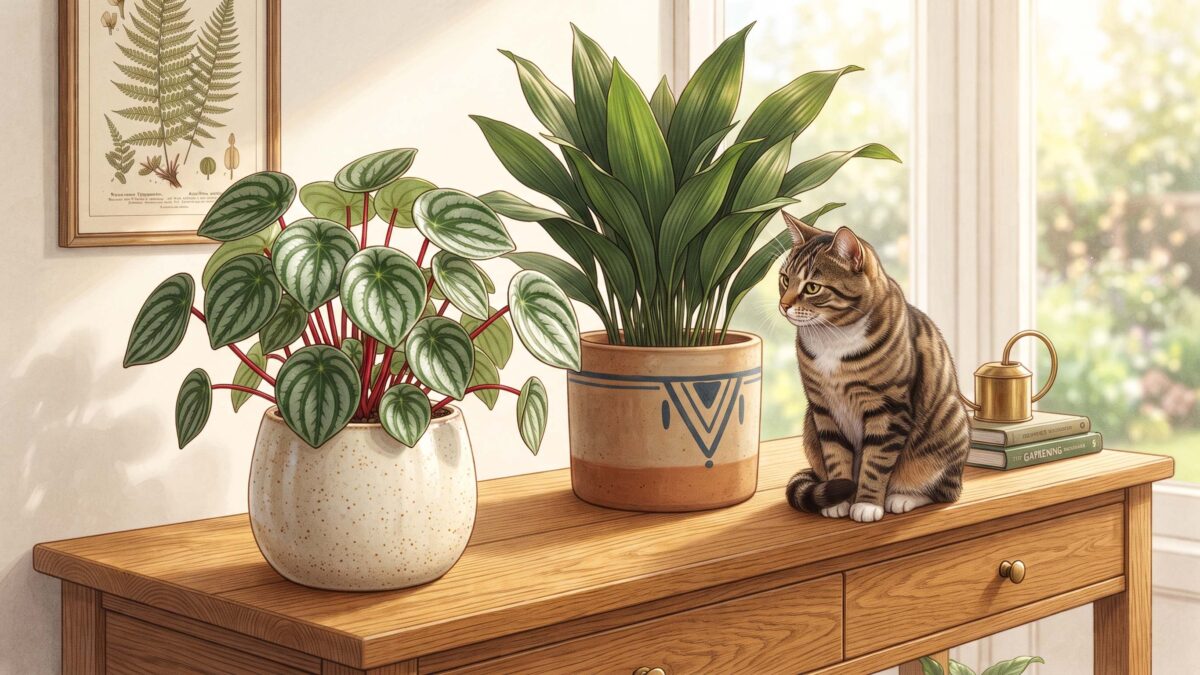
Finding pet-safe foliage plants requires looking past nursery marketing and checking botanical families. Many of the most popular indoor foliage plants—including Monstera, Philodendron, pothos (Epipremnum aureum), and ZZ plant (Zamioculcas zamiifolia)—belong to the arum family (Araceae), whose leaves pack microscopic needle-shaped crystals that irritate a cat’s or dog’s mouth on the first bite.
Fortunately, several major plant families produce patterned, architectural, and trailing leaves without those chemical defenses. Below are 12 non-toxic foliage houseplants cross-checked against the ASPCA Animal Poison Control Center database and Kew’s Plants of the World Online, grouped by the indoor light they need.
Why common aroids and dracaenas are toxic to cats and dogs
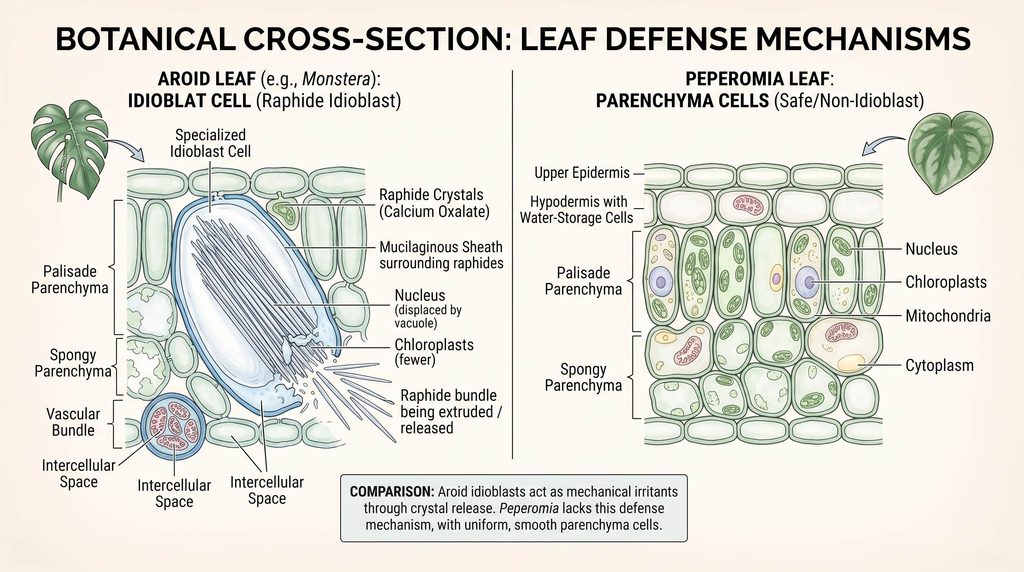
Before choosing safe alternatives, it helps to understand what makes certain leaves hazardous. Plant toxicity is not random; it follows evolutionary lineages.
- Insoluble calcium oxalate crystals (Araceae): Aroids such as Dieffenbachia, Philodendron, Epipremnum, Aglaonema, and elephant ear plants (Alocasia, Colocasia, and Xanthosoma) store bundles of needle-sharp calcium oxalate crystals called raphides inside specialized defensive cells known as idioblasts. When a pet chews a leaf, these cells rupture and fire the needles into the soft tissue of the tongue, gums, and throat, causing immediate burning, drooling, and swelling.
- Steroidal saponins (Asparagaceae): Snake plants (Dracaena trifasciata, formerly Sansevieria) and dragon trees (Dracaena marginata, Dracaena fragrans) contain saponins that trigger nausea, vomiting, and dilated pupils in cats and dogs.
- Furocoumarins and proteolytic enzymes (Moraceae): Rubber plants (Ficus elastica) and fiddle-leaf figs (Ficus lyrata) bleed a milky latex sap from broken veins that irritates both skin and the digestive tract.
Why It Works: Choosing plants from families that rely on tough leaf fibers or rapid growth rather than crystal idioblasts or latex sap—such as Marantaceae (prayer plants), Arecaceae (true palms), and Polypodiaceae (true ferns)—eliminates the risk of chemical tissue burns if a curious pet takes a bite.
12 ASPCA-verified pet-safe foliage plants by light level
Even a non-toxic leaf can cause mild stomach upset or mechanical gagging if a cat eats a large fibrous frond. However, the 12 species below carry no systemic toxins or crystal raphides.
Medium indirect light (75–150 foot-candles)
- Red Prayer Plant (Maranta leuconeura): Native to Brazilian rainforests, this low, spreading perennial carries oval dark green blades marked with magenta herringbone veins. Like its relatives in the arrowroot family, its blades fold their leaves upward at night through turgor shifts at the top of the petiole.
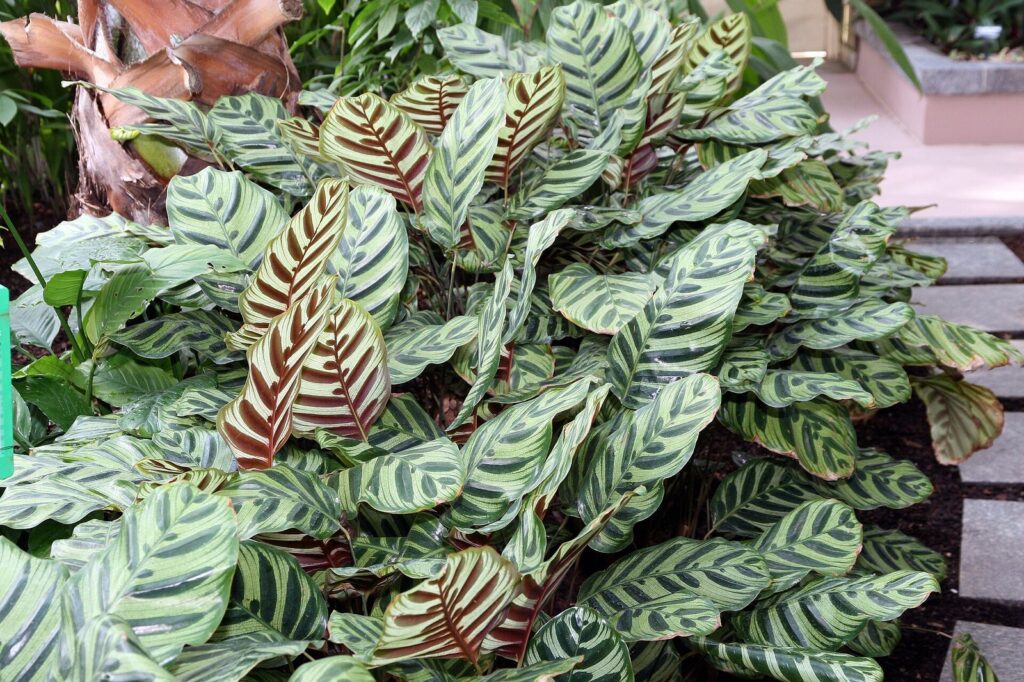
- Peacock Plant (Goeppertia makoyana, syn. Calathea makoyana): Translucent cream-green blades painted with dark green brush strokes on top and deep purple beneath. Because its leaf blades are paper-thin, it belongs in a grouping of humid tropical plants kept at 50% to 65% relative humidity.
- Rattlesnake Plant (Goeppertia insignis, syn. Calathea lancifolia): Wavy, lance-shaped pale green leaves alternating with dark olive blotches and burgundy undersides. Its upright habit makes it a safe substitute for toxic Dieffenbachia in bright corners.
- Watermelon Peperomia (Peperomia argyreia): Compact rosettes of thick, shield-shaped (peltate) leaves striped in metallic silver and dark green on red petioles. It stores water in its succulent-like epidermis and prefers to dry slightly between waterings.
- Baby Rubber Plant (Peperomia obtusifolia): Glossy, spoon-shaped leathery leaves that deliver the thick texture of Ficus elastica on a 10-inch tabletop frame without toxic latex sap. Cultivars with variegated leaves need the brighter end of the medium light band.
- Spider Plant (Chlorophytum comosum): Arching, linear green-and-white blades that send out cascading plantlets on long stolons. While non-toxic, its grass-like ribbons strongly attract cats; hang it in a basket if your cat tends to graze.
Low to medium indirect light (25–150 foot-candles)
- Cast-Iron Plant (Aspidistra elatior): One of the few members of Asparagaceae verified non-toxic to pets. Its leathery, dark green lance-shaped blades rise directly from an underground rhizome and tolerate deep room shade (25–75 foot-candles) and dry indoor air.
- Parlor Palm (Chamaedorea elegans): A true palm from Mexican cloud forests that stays under four feet indoors, offering feathery pinnate fronds. Note: never confuse true palms with the sago palm (Cycas revoluta), a cycad that is fatally hepatotoxic to dogs and cats according to the UC Davis School of Veterinary Medicine.
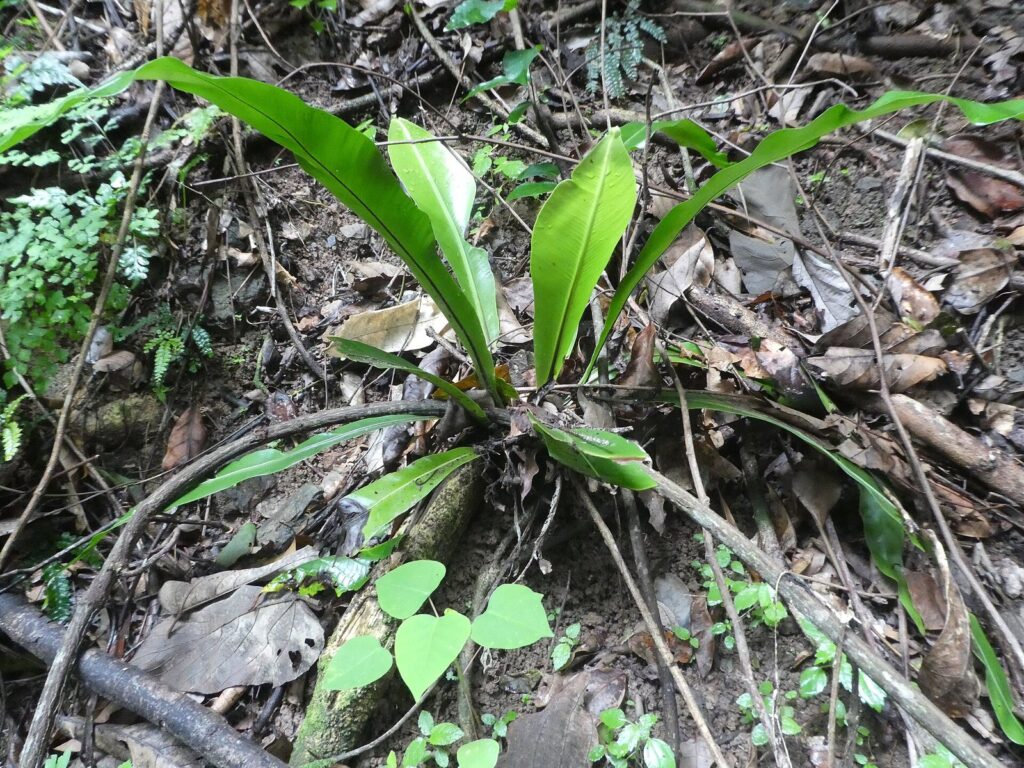
- Bird’s Nest Fern (Asplenium nidus): Instead of feathery divided fronds, this epiphytic fern grows a rosette of undivided, apple-green long leafy plants blades with wavy margins and a dark midrib.
- Boston Fern (Nephrolepis exaltata): Arching fronds packed with soft green pinnae. Unlike toxic asparagus ferns (Asparagus aethiopicus, which are not true ferns), Nephrolepis is completely safe for pets.
Terrarium and high-humidity foliage
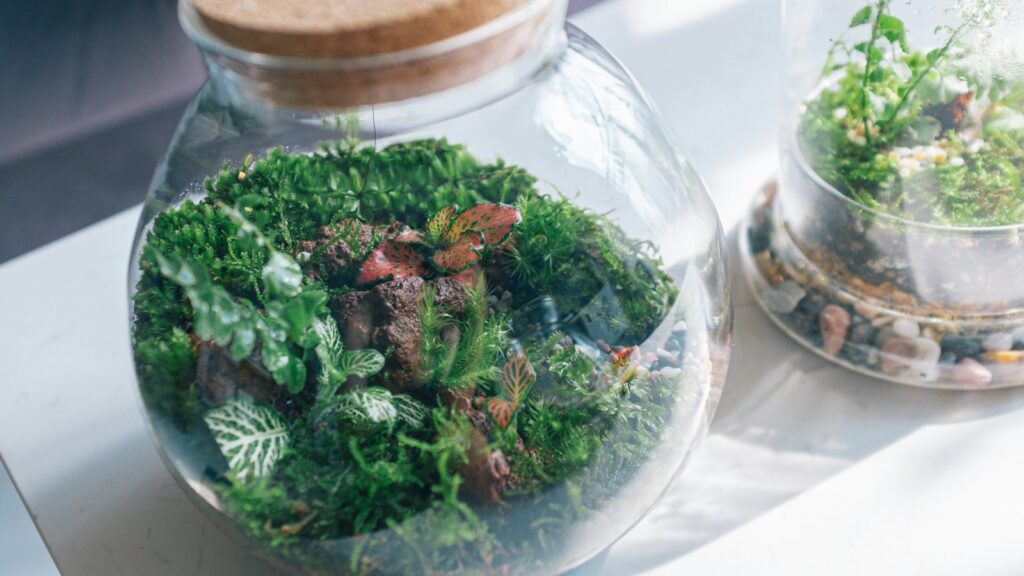
- Nerve Plant (Fittonia albivenis): Low-creeping stems with dark green leaves netted in crisp white, pink, or carmine veins. Because it wilts dramatically in dry living rooms, it is one of the best choices for closed terrarium ideas—which also keeps its leaves behind glass and away from paws.
- Polka Dot Plant (Hypoestes phyllostachya): Freckled pink, white, or red blades from Madagascar that add bright color to tabletop groupings of tropical houseplants without the toxicity of crotons (Codiaeum variegatum) or caladiums.
Quick comparison: Toxic houseplants vs. pet-safe swaps
Use this swap table when replacing hazardous plants in a home with cats or dogs:
| Common Toxic Houseplant | Toxic Compound | Pet-Safe Foliage Alternative | Shared Visual Trait |
|---|---|---|---|
| Snake Plant (Dracaena trifasciata) | Steroidal saponins | Cast-Iron Plant (Aspidistra elatior) | Upright, tough, low-light architectural blades |
| Rubber Plant (Ficus elastica) | Irritant latex sap | Baby Rubber Plant (Peperomia obtusifolia) | Thick, glossy, rounded dark green or variegated leaves |
| Dumb Cane (Dieffenbachia seguine) | Calcium oxalate raphides | Peacock Plant (Goeppertia makoyana) | Bold, patterned cream-and-green interior leaves |
| English Ivy (Hedera helix) | Triterpenoid saponins | Swedish Ivy (Plectranthus verticillatus) | Trailing scalloped green stems for shelves and baskets |
| Asparagus Fern (Asparagus aethiopicus) | Sapogenins | Boston Fern (Nephrolepis exaltata) | Fine, arching, feathery green fronds |
How to verify plant names before you buy
Common names frequently overlap between safe and toxic species. “Lily,” “palm,” and “fern” are applied to dozens of unrelated genera. Before bringing a new plant home:
- Check the Latin binomial on the pot tag: Confirm the exact genus and species in the ASPCA database rather than searching by a trade nickname.
- Watch out for toxic lookalikes: True lilies (Lilium and Hemerocallis) cause acute kidney failure in cats from even a few grains of pollen, whereas the peace lily (Spathiphyllum) is an aroid containing calcium oxalate crystals. Neither belongs within reach of cats.
- Keep soil toppings pet-safe: Avoid cocoa hull mulch or bone meal fertilizers in indoor pots, as both attract dogs and contain compounds harmful if ingested.

Questions & observations