

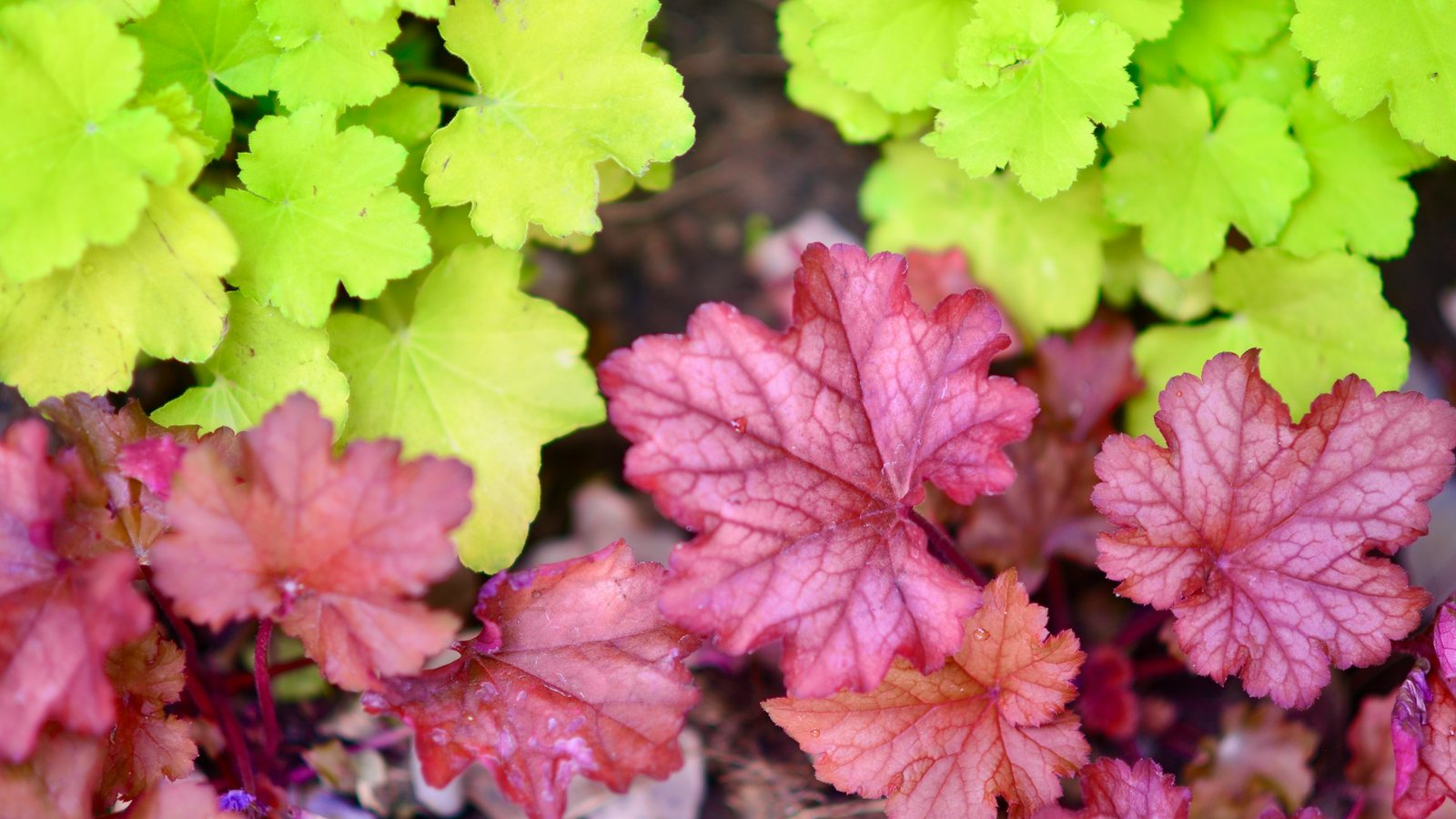
Colorful foliage perennials give a bed color from spring to frost and then come back the next year. A purple coral bell or a gold sedge stays colorful for months, while most flowers last two or three weeks. Because they return, you choose them once and adjust them for years.
Many bright leaves at the garden center belong to tender plants such as coleus, hardy only in Zones 10 and 11. Those appear in our list of plants with multicolored leaves. This guide covers plants that survive winter in the ground across a stated USDA zone range.
Why do some perennials have different colored leaves?
Leaf color comes from the balance of pigments and the leaf surface. University of Wisconsin–Madison Extension explains that yellow carotenoids sit in leaves all season, hidden by green chlorophyll. A colored leaf adds other pigments, carries less chlorophyll, or reflects light off its surface.
Perennials with different colored leaves change that balance in one of four ways. Knowing which one a plant uses tells you how it will react to light.
- Purple, burgundy, and red: anthocyanin pigments mask the green. Heuchera and stonecrop cultivars use this route.
- Gold and chartreuse: reduced chlorophyll lets carotenoids show. These leaves often scorch in strong afternoon sun.
- Silver and gray: dense hairs or waxy coatings reflect light from the leaf surface.
- Variegated: patches of tissue lack chlorophyll entirely, a pattern explained in our guide to how plants become variegated.
Why it works
A gold or variegated leaf has less chlorophyll to work with. It needs more light than a green leaf to make the same amount of sugar. Too much shade and the plant either greens up or grows weakly.
If you are new to plants grown for leaves, our overview of foliage plants covers the basics. The list below sticks to hardy perennial plants with colorful foliage.
Coral bells lead the colorful foliage perennials
No perennial group offers more leaf colors than Heuchera. Breeders have produced cultivars in lime, amber, caramel, purple, and silver. Native Heuchera americana is rated for USDA Zones 4 to 9 by Missouri Botanical Garden.
That range of choice is also the problem. Mt. Cuba Center evaluated 83 Heuchera cultivars over three years, from 2012 to 2014. The trial concluded the market offers an excessive number of choices, with some cultivars released before adequate testing.
The lime-leaved ‘Citronelle’ earned the top score, 4.7. ‘Bronze Wave’, ‘Cajun Fire’, ‘Color Dream’, and ‘Steel City’ followed at 4.5 each. All of them descend from two eastern US natives, Heuchera americana and Heuchera villosa.
Field note
How much leaf color survives winter depends on how cold it gets. In cold-winter areas, Missouri Botanical Garden recommends a winter mulch applied after the ground freezes. The mulch helps prevent root heaving.
Perennial plants with colorful foliage, by leaf color
Each entry below lists the USDA zone range from Missouri Botanical Garden’s Plant Finder. Use it with your own zone, and treat the outer edges of a range with caution.
Purple and burgundy
Stonecrop ‘Chocolate Cherry’, Hylotelephium ‘Chocolate Cherry’, forms upright clumps of glossy, purple-gray leaves about 14 inches tall. It is rated for Zones 4 to 9 and wants full sun with sharp drainage. In too much shade, the stems flop.
Bugleweed, Ajuga reptans, makes a low mat of glossy leaves, and its cultivars come in bronze, burgundy, and tricolor. The species is rated for Zones 3 to 10. Its best leaf color comes with three to four hours of sun a day.
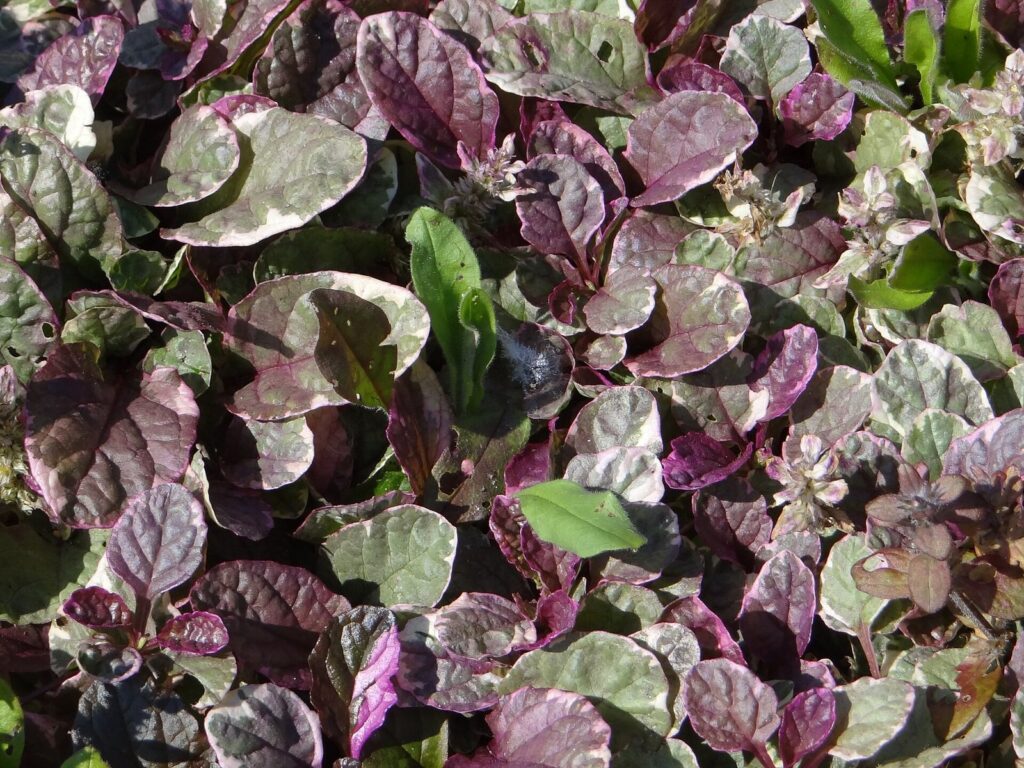
Bugleweed spreads quickly by runners, so it works best as a low maintenance perennial ground cover rather than in a mixed border. Missouri Botanical Garden lists it as invasive in some areas, so check your state’s list first.
Gold and chartreuse
Japanese forest grass, Hakonechloa macra ‘Aureola’, is the classic gold perennial for part shade. It is hardy in Zones 5 to 9 and shifts from gold to lime green in deeper shade. Its profile describes the light window clearly.
Plant foliage will burn in full sun locations and lose color intensity (particularly on variegated leaf cultivars) in full shade.
Missouri Botanical Garden Plant Finder, Hakonechloa macra ‘Aureola’
Carex oshimensis ‘Everillo’ is a fine-textured sedge with chartreuse to gold leaves. Missouri Botanical Garden rates it for Zones 5 to 9 and notes its color is richer in part shade than in sun. It stays evergreen through most of that range, though it dislikes hot, humid summers.
Silver and gray
Lungwort cultivars carry the most silver for shade. Pulmonaria ‘Berries and Cream’ has ruffled, silvery leaves splotched with green and is rated for Zones 3 to 8. It handles heavy shade better than most silver plants.
Japanese painted fern, Athyrium niponicum var. pictum, adds silver and maroon fronds in Zones 3 to 8. Its silvering is strongest for several weeks in spring, then greens up in summer heat. For sunny beds, silver options such as lamb’s ears are covered in our guide to full sun foliage plants.
Variegated cream and pink
Variegated forms of Persicaria virginiana, such as ‘Painter’s Palette’, carry creamy white variegation with pink splotches. Missouri Botanical Garden rates the Variegata Group for Zones 5 to 8, in part shade with consistently moist soil.
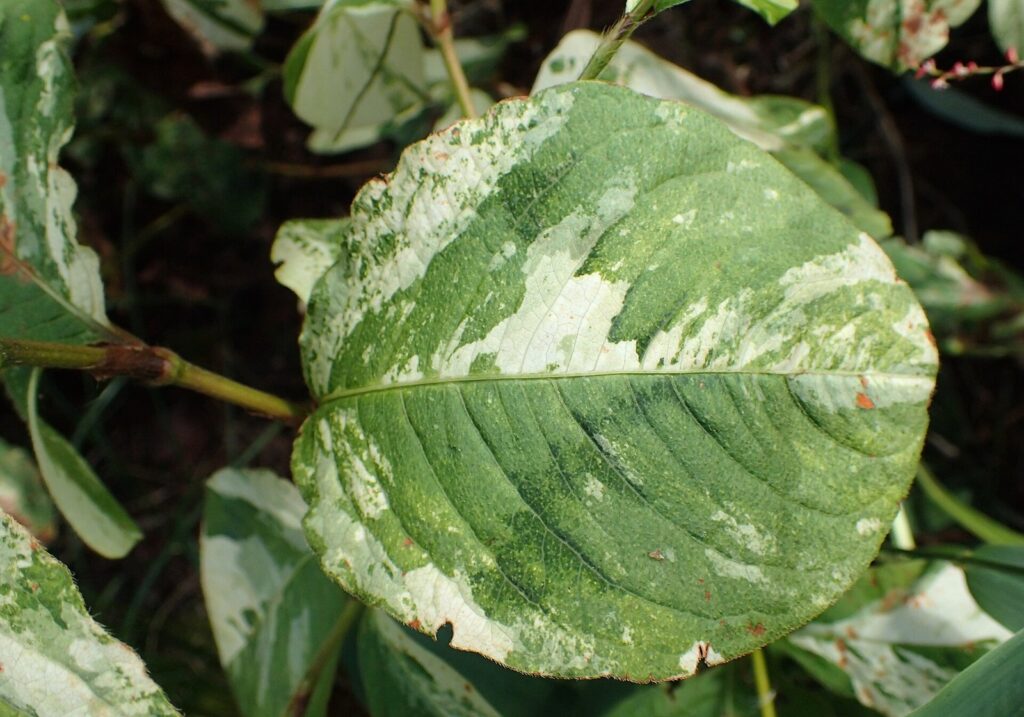
This plant needs space. Missouri Botanical Garden warns it can spread aggressively by rhizomes and self-seeding in good conditions. Give it a corner where it can fill in.
| Perennial | Leaf color | USDA zones | Light |
|---|---|---|---|
| Heuchera americana and hybrids | Lime to deep purple | 4 to 9 | Sun to part shade |
| Hylotelephium ‘Chocolate Cherry’ | Purple-gray | 4 to 9 | Full sun |
| Ajuga reptans | Bronze, burgundy, tricolor | 3 to 10 | Sun to part shade |
| Hakonechloa macra ‘Aureola’ | Gold striped | 5 to 9 | Part shade |
| Carex oshimensis ‘Everillo’ | Chartreuse | 5 to 9 | Part shade |
| Pulmonaria ‘Berries and Cream’ | Silver | 3 to 8 | Part to full shade |
| Athyrium niponicum var. pictum | Silver and maroon | 3 to 8 | Part to full shade |
| Persicaria virginiana (Variegata Group) | Cream and pink | 5 to 8 | Part shade |
Keeping leaf color strong year after year
Light is the first adjustment. Purple leaves hold color best with some direct sun, while gold leaves need protection from hot afternoon sun. If a plant fades, move it before you replace it.
Variegated perennials sometimes throw all-green shoots. Missouri Botanical Garden advises removing non-variegated leaves on bugleweed as soon as they appear. The same rule applies to any variegated perennial.
Division keeps clumps vigorous. Missouri Botanical Garden suggests dividing Heuchera americana every three to four years in spring.
Once you know which colors hold up in your light, combining them is a design question. Our guide to building a foliage garden covers contrast, layering, and where each leaf color belongs.
Questions & observations